
The March 30th monthly briefing covered a significant amount of ground — from marketing performance and product updates to B2B strategy, legal documentation, and the company’s broader vision for monetization. Here is a full breakdown of everything shared.
Organic Growth Is Accelerating
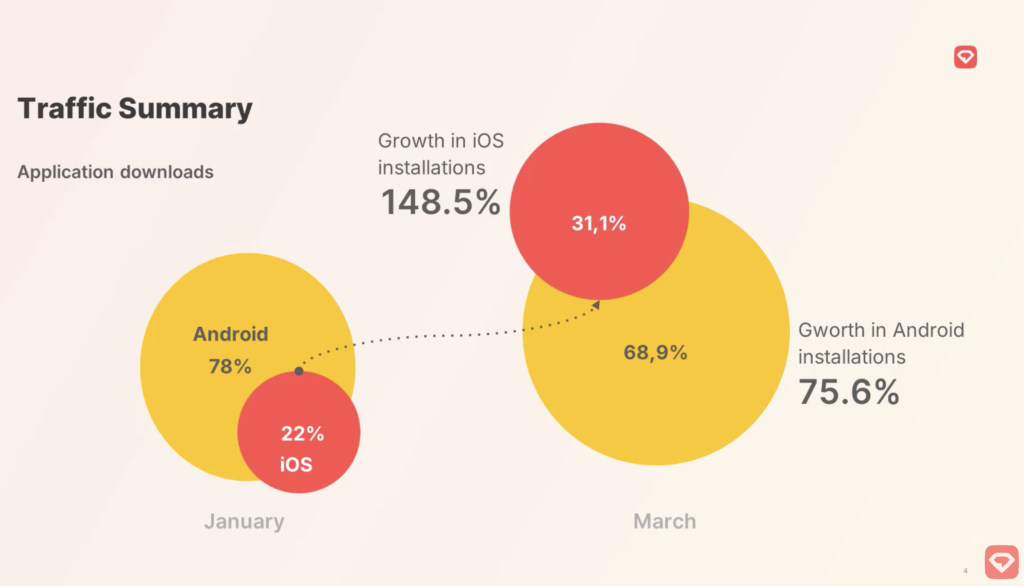
The numbers from the first quarter tell a clear story. January established the baseline. February brought a 44% increase in organic downloads. March delivered an 80.6% surge — a significant inflection point that signals the platform is beginning to generate self-sustaining momentum.
This kind of growth is not driven by advertising spend. These are users finding Gem Space on their own — through word of mouth, unpaid articles, and organic discovery. iOS now accounts for 31% of new installations, up from 22% in January. Messages sent in March increased by 83% compared to the previous month. User retention also improved by 4%, meaning people are returning to the app more frequently.
The platform is transitioning from controlled growth into accelerated adoption — exactly the pattern seen in scalable digital platforms at this stage of development.
Navigation Update: Measurable Impact on User Behavior
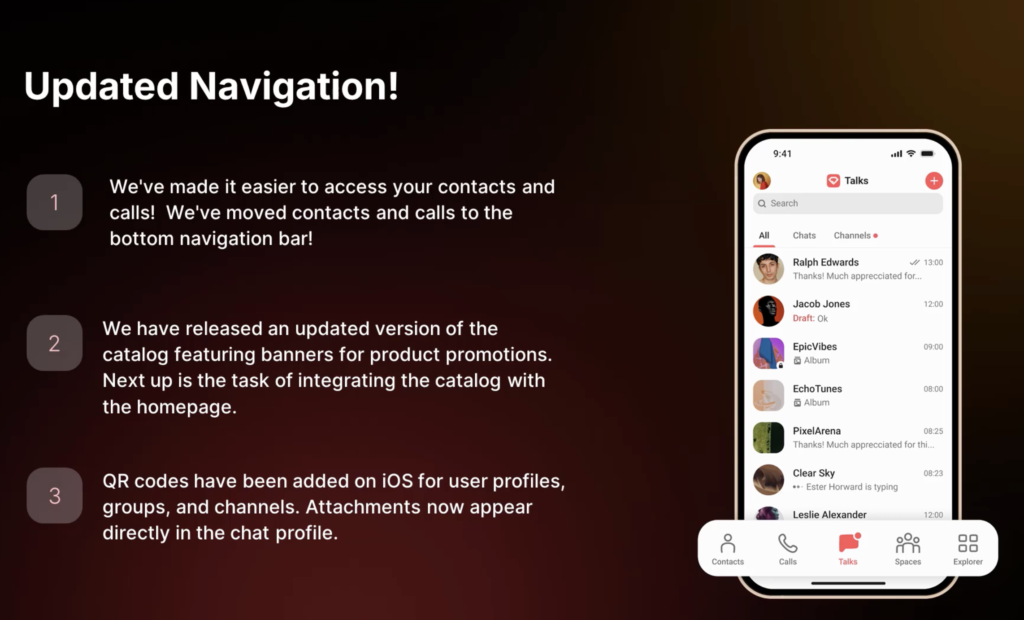
The March 26th release introduced a redesigned navigation structure — one of the most significant product changes in recent months. Contacts and calls moved to the bottom menu, the catalog was updated, QR codes were introduced on iOS, and a personal contact link was added to every profile.
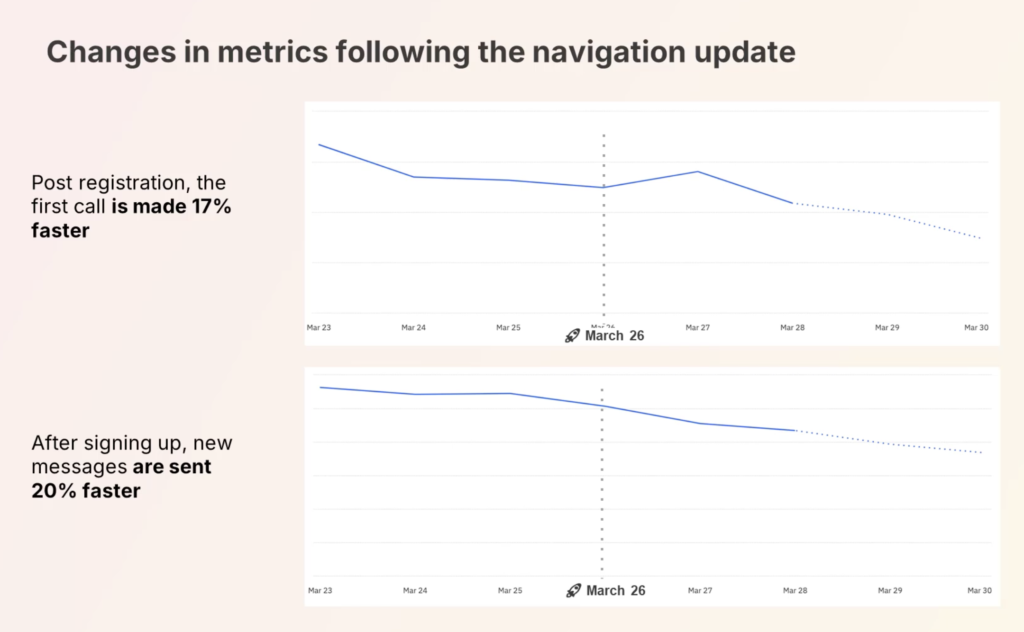
The impact on key metrics was immediate. After the release, users made their first call 17% faster compared to before. The speed of sending the first message improved by 20%. These are meaningful indicators that the changes are working — lowering friction and helping new users get value from the app faster.
The personal contact link deserves specific mention. Rather than searching for a user by username, anyone can now share a direct link that opens a chat instantly — or prompts the recipient to download the app first. This feature was introduced specifically to simplify onboarding for new users, and early data supports its effectiveness.
What’s Coming Next for Gem Space
Several near-term development priorities were outlined during the briefing.
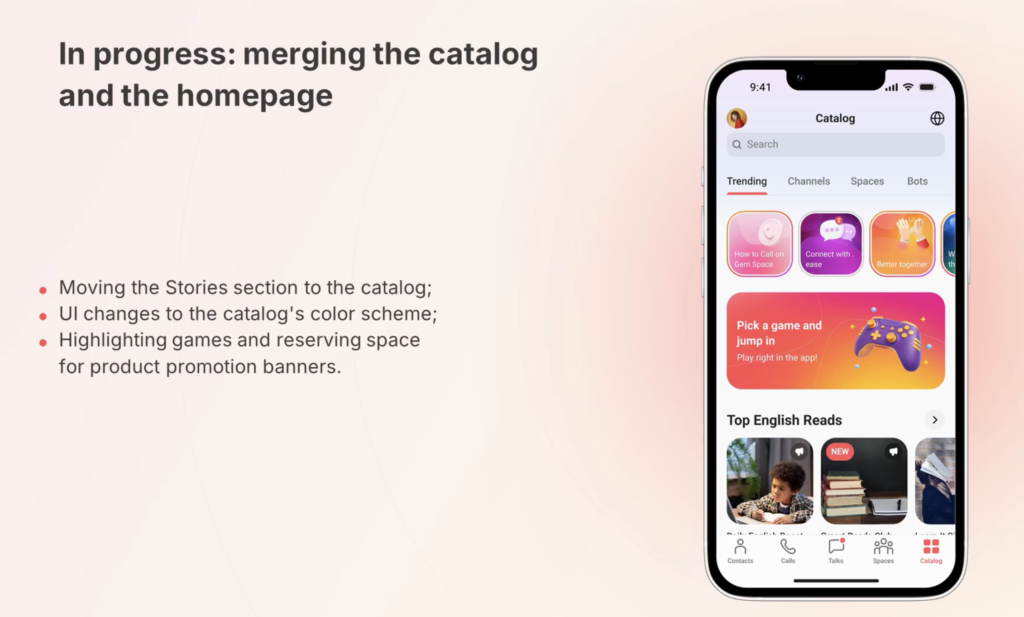
The catalog is being transformed into a hybrid of the former homepage and the existing catalog — combining stories, feature promotions, and a tile-based layout for channels and Spaces. The interface will receive a visual refresh with a gradient design.
Personalization features are in development, including customizable ringtones for calls and notifications — a frequently requested feature that makes the app feel more personal. Contact management is also being improved, with better options for editing, deleting, and syncing contacts.
The video circle button is being separated from the voice message button to make it more accessible and intuitive — a change aimed at increasing engagement with this feature, particularly among younger users.
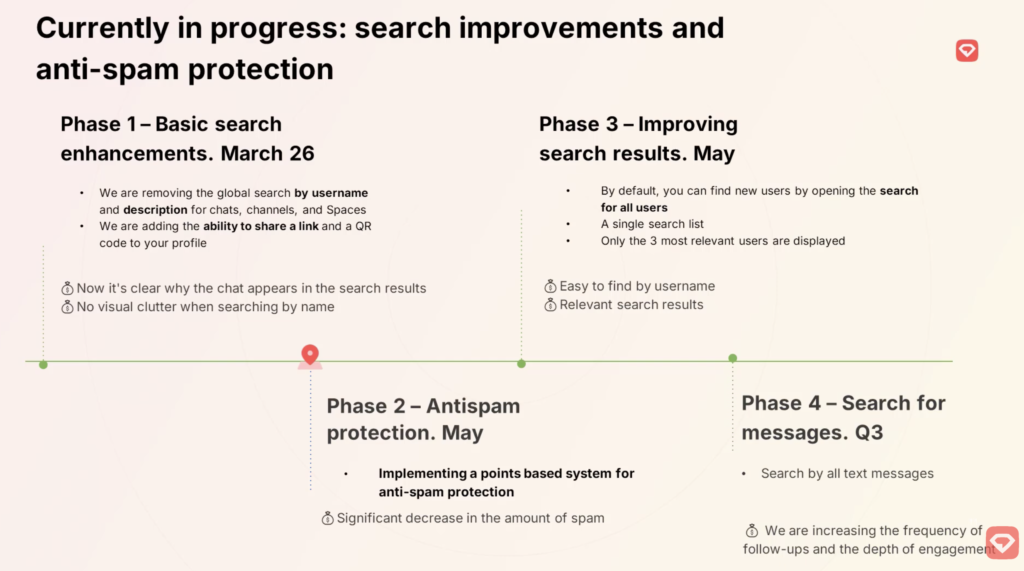
Search is being upgraded in phases. The first phase — released on March 26th — improved search relevance by focusing on nicknames and chat names rather than descriptions. The second phase introduces an anti-spam point system, where accounts that engage in suspicious behavior see their ability to create new chats restricted. The third phase will improve result relevance further. The fourth and most anticipated phase — global message search across all chats — is planned for the third quarter of this year.
Stories are confirmed as part of the near-term roadmap and will have a dedicated place in the updated catalog section. Ringtones and video circles are also prioritized for younger audiences.
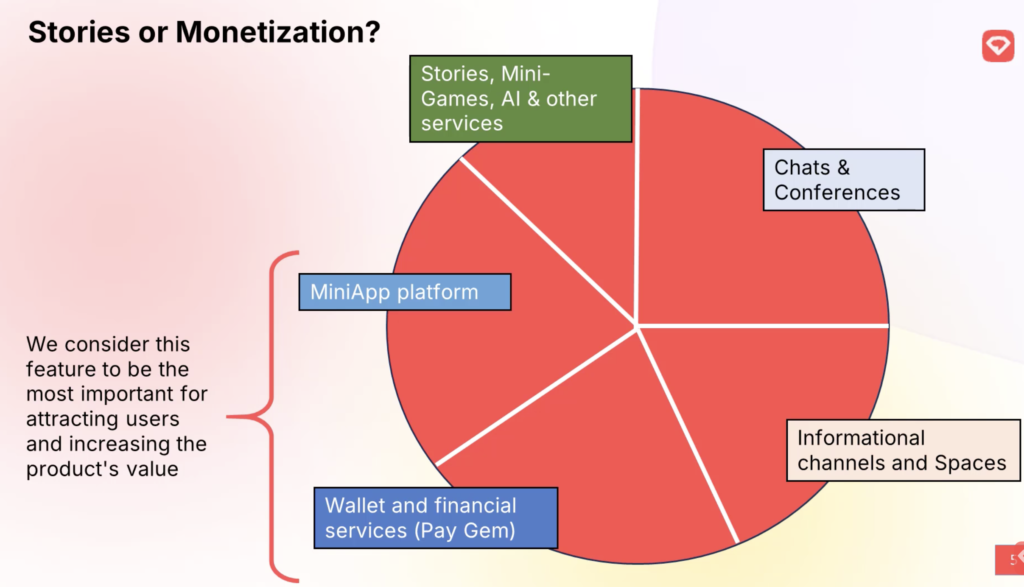
The Priority: Monetization
The most strategically important development covered in the briefing is the monetization roadmap for Gem Space.
Eighty percent of current development time is dedicated to two features: the mini-app platform and PayGem — the platform’s wallet and financial services layer.
The mini-app platform will allow third-party companies to bring their services and products directly into the Gem Space ecosystem — similar in principle to how WeChat operates in China. This opens an entirely new revenue model for the platform and significantly increases its valuation basis.
PayGem will support multiple payment environments simultaneously: a card-based acquiring solution for Russia and Belarus, a fiat currency solution through the company’s Canadian entity supporting dollars, euros, pounds, and Canadian dollars, and a cryptocurrency-based solution for markets where digital assets are the preferred payment method.
Both features are expected to launch in spring of this year. As auditors have confirmed, the introduction of internal financial flows immediately and significantly increases platform valuation. This is the core of what the company has called its “year of money.”
Gem Team: Three Products, Full Market Coverage
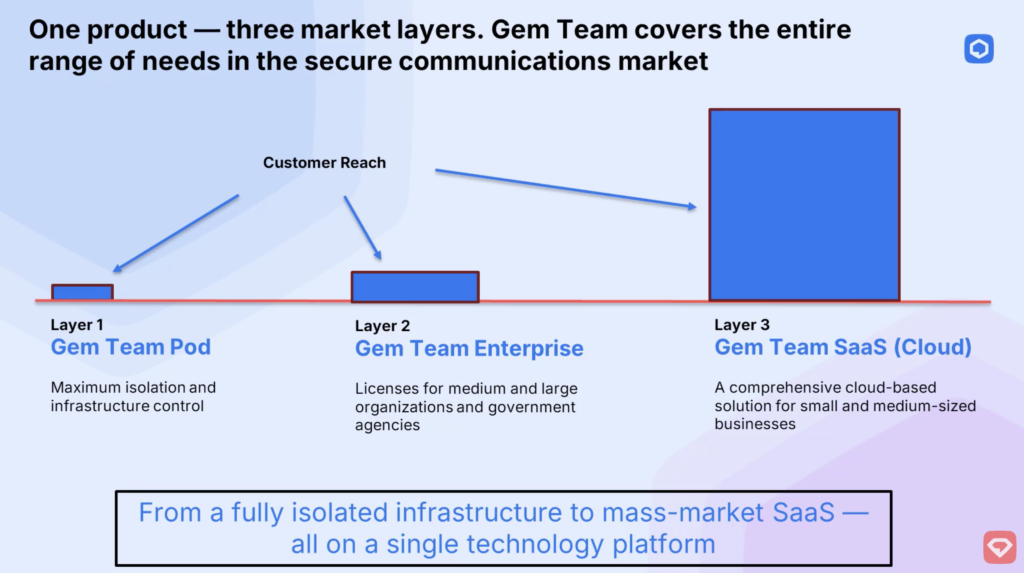
The B2B side of the business also received a detailed update, with the product line now clearly structured into three distinct offerings.
- Gem Team Pod is a dedicated server solution designed for organizations requiring maximum data protection and full isolation. All data remains on a single server — which can be physically secured or destroyed if necessary. This solution targets family offices, investment firms, and organizations operating in high-security environments. It supports up to 200 or more servers and up to 500 users.
- Gem Team Enterprise is the cloud or on-premise solution for large organizations with over a thousand employees. Two licenses have already been sold — one in August, one in December — with both clients satisfied and renewals expected. A third license is actively in negotiation.
- Gem Team Cloud is the newest addition and the largest addressable market. It is a subscription-based cloud solution for small and medium-sized businesses — registration takes one minute, a 14-day free trial with full functionality is included, and payment is handled by card with automatic recurring billing. Each client operates within a completely isolated digital environment on shared infrastructure. Monthly and annual subscriptions are available.
The cloud solution is already in development. The admin panel has been built, the registration flow is complete, and the team is currently working on authorization, user management, regional acquiring integration, data localization compliance, and multi-tenancy — which will allow seamless migration from the cloud product to the on-premise solution while retaining all chat history and user accounts.
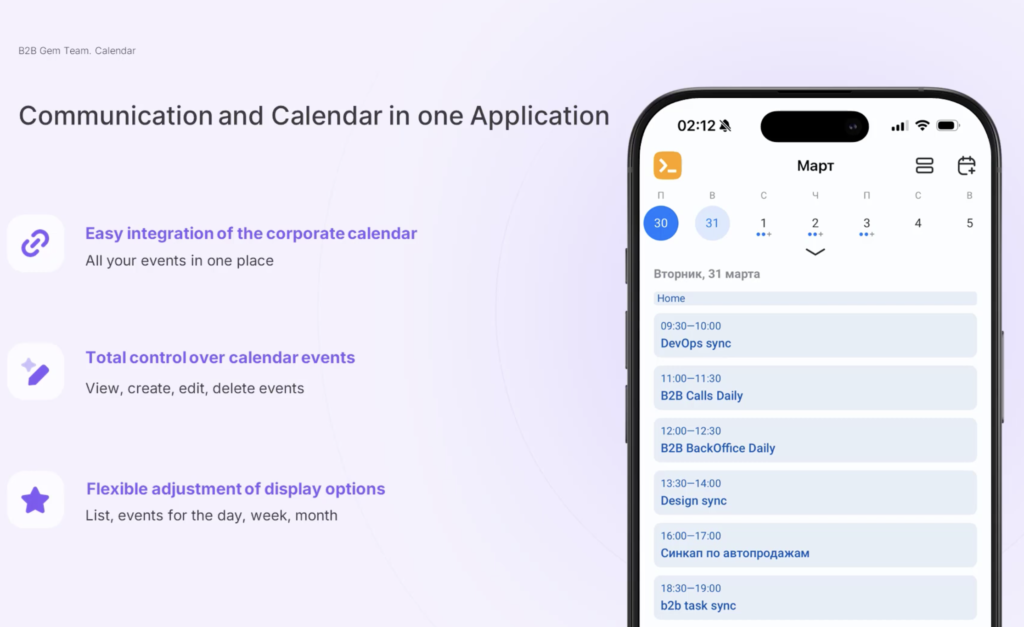
The calendar feature — released in mid-March — is now live on iOS and web, with Android coming shortly. It currently integrates with Google, with Microsoft Exchange and other corporate calendar systems to follow. Events sync automatically, recurring meetings can be configured with flexible rules, and a call link is automatically added to every meeting created within Gem Team — eliminating the need to switch between screens.
Legal Structure and Shareholder Documentation
A detailed update was provided on the legal framework and shareholder documentation.
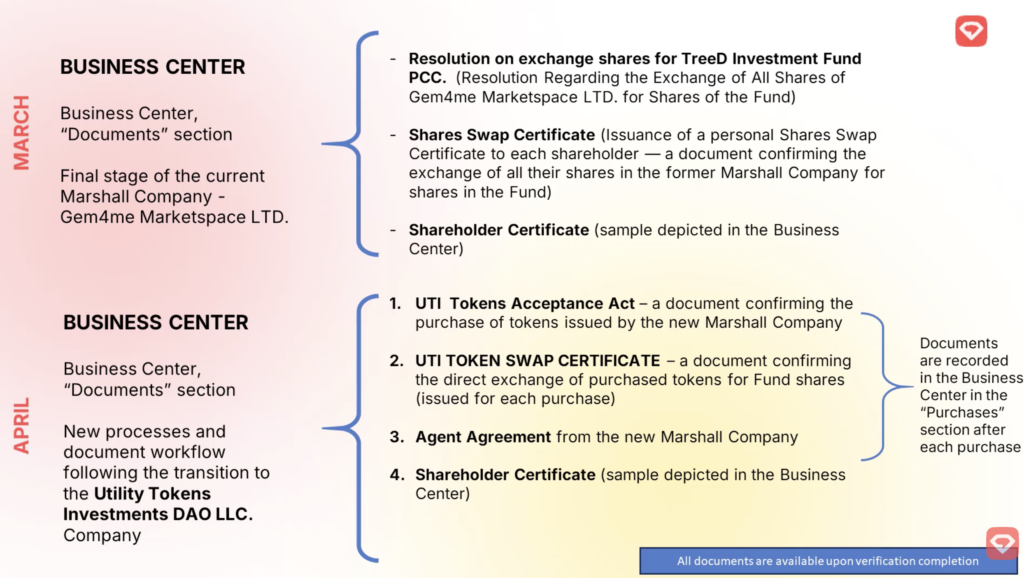
Investments are structured through token purchases, which are immediately converted into fund shares as a second step. In April, online document signing will be introduced, allowing shareholders to receive and download signed copies of their subscription agreements and related documents directly from their personal accounts.
The documents being made available include the subscription agreement, appendices for Class A and Class D shares, and a document governing the accrual of complimentary shares. The company is also transitioning to a new Marshall Islands entity — Utility Token Investments DAO LLC — which replaces the original company and brings an updated legal and technological framework. The business center will be updated accordingly during April.
The fund is regulated by the Financial Services Commission of Mauritius. Shareholder rights are protected under that jurisdiction, and all purchases are reflected in the business center.
On the question of taxation — in regional sales, Class A shares remain with the shareholder and payments are classified as dividends. In the event of a global sale, Class A shares are transferred to the buyer and the income would be classified as capital gains. The board expressed confidence that both scenarios represent a highly profitable outcome for investors.
Middle East: Active and Accelerating
Ten Gem Team demo deployments are currently live in Qatar. A queue of 50 additional demo requests has formed from neighboring countries. The team is back on the ground in both Qatar and Saudi Arabia following the conclusion of Islamic holidays, with active negotiations underway on country-specific licensing agreements.
The events unfolding across the region have accelerated — not slowed — demand. Governments and private organizations are concluding that secure, sovereign communication infrastructure is no longer optional. Gem Soft remains one of the very few providers capable of delivering a fully deployable, source-code-controlled communication platform that can operate entirely within a country’s own infrastructure.
A VIP club meeting with live connection to the team on the ground in Qatar is scheduled for April 9th, where detailed updates on active deals and regional sales progress will be shared directly.
The Bigger Picture
What is taking shape is not simply a product update cycle — it is the systematic buildout of a full-spectrum communication infrastructure company.
Gem Space covers the consumer and national messenger market. Gem Team covers corporate and government secure communications across three distinct product tiers. PayGem and the mini-app platform will introduce internal monetization. Regional licensing deals are advancing in parallel with negotiations for a global strategic sale.
The platform has 50+ million users. The valuation is confirmed at over $2 billion. Organic growth is accelerating. And the demand for sovereign, secure communication — from governments, corporations, and individuals — is only growing.
Stay informed — join our Angels Team channel in Gain Space.
Comments are closed