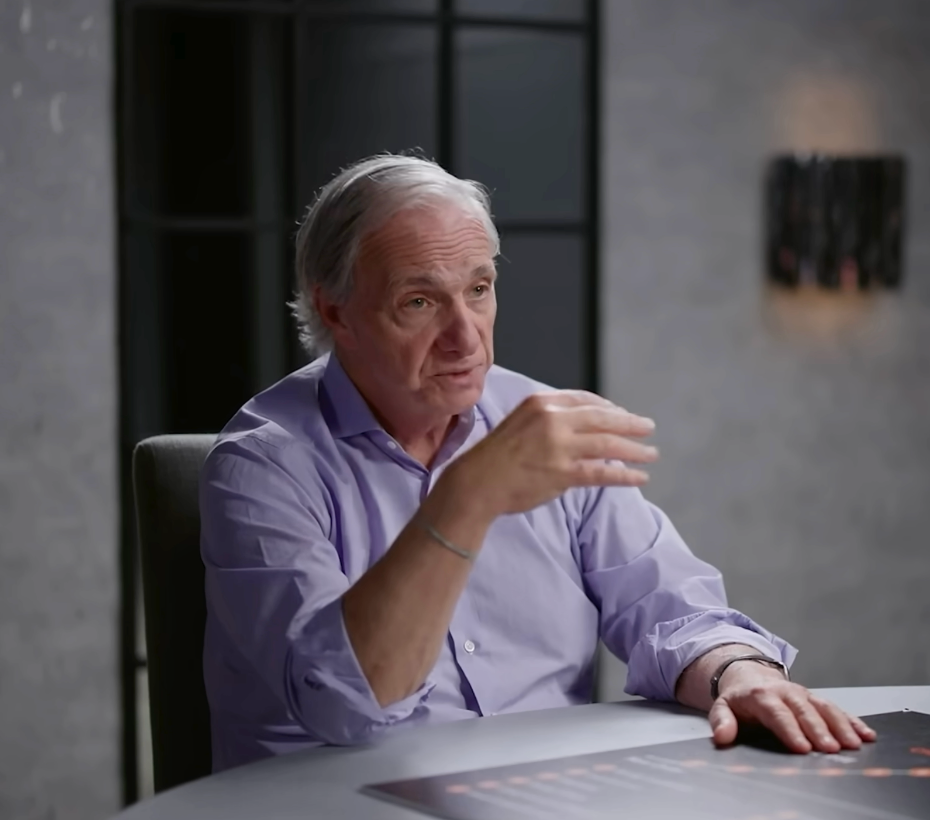
Ray Dalio—billionaire and founder of Bridgewater Associates, the world’s largest hedge fund with over $120 billion in assets under management. With over 50 years of experience as a global macro investor, he grew Bridgewater from a two-bedroom apartment into an industry legend. He’s the #1 New York Times bestselling author of Principles and is often called “the Steve Jobs of investing“.
Let’s cut to the chase.
AI Assistants Are the New Currency of the Digital Economy
For two centuries, the global economy ran on one thing: human time.
Most people trade their 20s through their 60s—knowledge, experience, time—for a salary.
That model is now shifting.
The new commodity isn’t human time—it’s the AI assistant.
This shift isn’t about AI replacing humans—it’s about everyday tasks being handled by digital helpers.
Unicorns are built on adoption, not tech.
Just look at the numbers.
In 2015, most people used perhaps one digital assistant—Siri, Google Assistant, and the like.
By 2020, that number had grown to several types of AI‑powered features, such as navigation, translation, voice control, and smart‑home automation.
Today, people use multiple AI services at once—ChatGPT, Gemini, Claude, Perplexity, Copilot, and dozens of specialized assistants.
ChatGPT alone now has over 800 million monthly active users, according to Similarweb. Gemini: 400M+, DeepSeek: 130M+, Claude: 100M+, Perplexity: 80M+.
But the most telling statistic is about scale.
What’s skyrocketing isn’t user count—it’s assistants per person.
If we project this trend, the math is staggering:
- 2015 – ~390M AI assistants.
- 2020 – ~6.4B.
- 2024 – ~70‑80B.
- 2026 – if we reach 50 assistants per person, that’s ~400B globally.
When creation costs approach zero, adoption goes vertical.
Now compare that to the biggest tech markets.
There are roughly 6.5 billion smartphones globally—and Apple and Samsung alone account for over 3 billion of them.
Tesla has only a few million vehicles on the road.
Even the largest satellite network, Starlink, has only tens of thousands of satellites.
All these products share one thing: every new unit requires materials, manufacturing, and distribution.
AI assistants operate on a fundamentally different economic model.
Building a foundational language model costs billions.
*But once that model exists, fine‑tuning a specialized assistant costs almost nothing to replicate and distribute via digital platforms.
The future belongs not to the creators of one‑off solutions, but to the owners of ecosystems that enable mass usage—to those who can support billions of daily AI interactions.*
In essence, the battle is no longer about building yet another chatbot.
The battle is for platforms that unify users, services, and billions of AI agents under one roof.
That’s why attention is shifting from standalone AI products to next‑gen digital platforms.
😇🫶
Gem Space fits this thesis perfectly. Gem Space isn’t trying to build the next LLM. Instead, it’s building the layer where AI services, mini‑apps, payments, spaces, and users all actually interact.
That is precisely the purpose of the Class D Shares: to accelerate Gem Space’s AI roadmap and long‑term monetization.
The industrial age ran on human hours. The digital age now runs on AI interactions.
To understand why, you need to ask the right question:
Not “which model is best?” but “which platform can scale hundreds of billions of daily AI interactions?”
So the real race isn’t about who has the best model.
Comments are closed