The September 21st briefing covered the full range of development activity across both B2C and B2B since the previous monthly session.
On the B2C side, the transition to a proprietary product analytics system is complete. The platform no longer relies on any third-party analytics solution — all data collection and metric analysis now runs on Gem Soft’s own infrastructure, giving the team full control and significantly reducing costs. Several patches improving the SSC connection — the underlying process that handles message delivery and chat performance — have also shipped. Mini-app sharing links are live, allowing users to share specific mini-apps directly with friends and contacts.
The media editing feature on Android — allowing users to crop, annotate, and trim photos and videos before sending without leaving the app — has also shipped, and is being used as a testing ground for new AI agent programming approaches and modern development processes.
The most significant upcoming B2C release is Gem Premium on September 29th. The payment system integration is complete — cloud payment, Google Play, and App Store payment systems are all integrated. The application now supports paid functionality, subscription management, payment history, receipt and document storage, and the ability to gift subscriptions to other users. The marketplace moderation review process has been submitted this week, with full confidence that approval will be in place for the September 29th launch date.
A second major technical track is also targeting completion by end of September: the final migration away from Google services onto Gem Soft’s own infrastructure. Almost all application functionality will be hosted on proprietary servers managed by the infrastructure team. Some components will remain on Google, but the migration is near-complete. The goal is for this change to be entirely invisible to users — the less noticeable, the more successfully it has been executed.
On the B2B side, the major 3.0 release has shipped — covering the full cloud platform launch, CRM system integration, payment management improvements, and over 100 smaller quality-of-life features for corporate clients. Active development continues on call transcription, in-call chat functionality for webinars and meetings, time-based message clearing, language selection for new regional markets, and interface mirroring for right-to-left languages including Arabic.
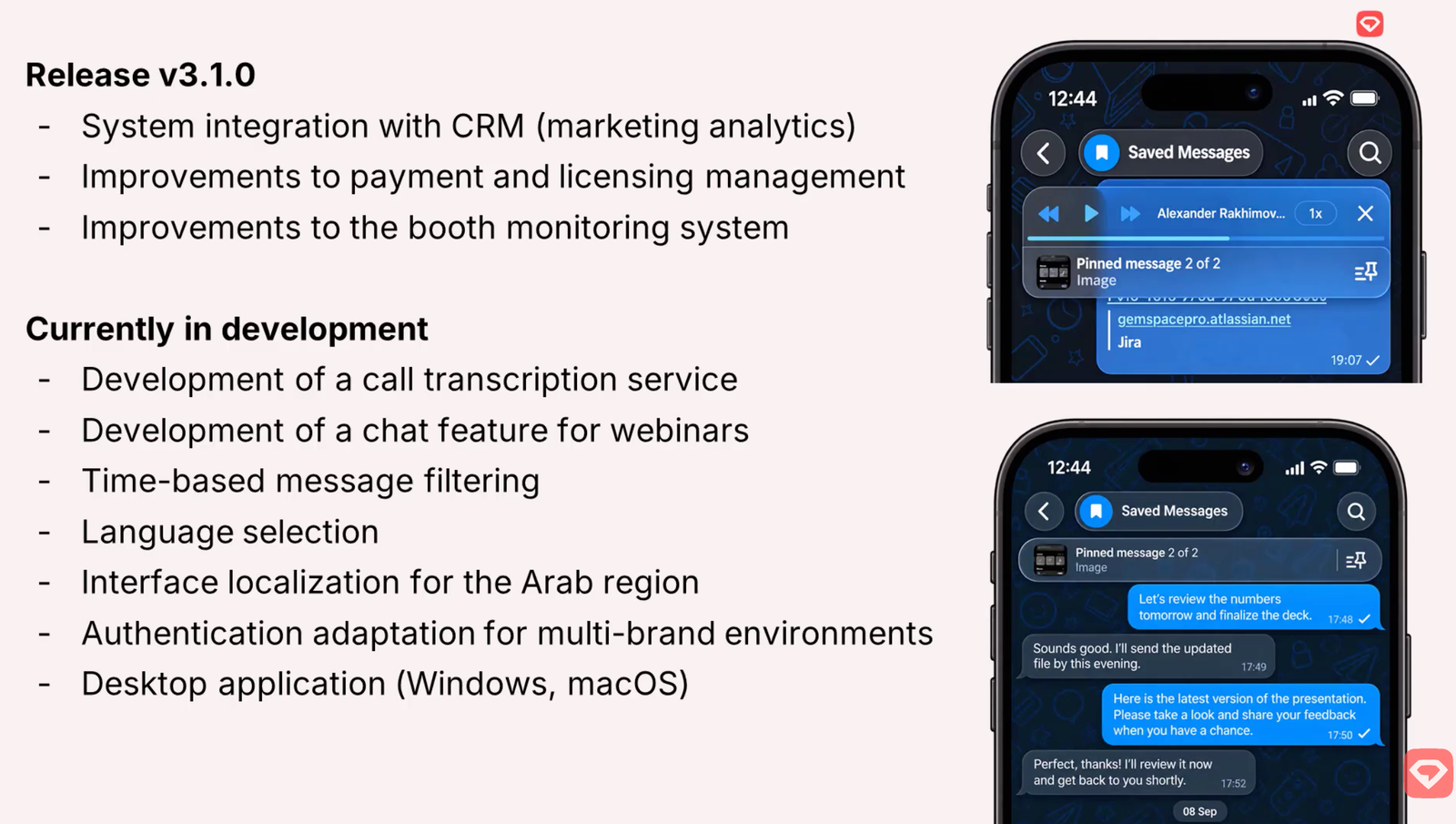
A new European brand is being prepared alongside existing Co-Work and Gem Team brands. The authentication system is being updated to support multi-branding — enabling all products to be assembled from a single codebase with a unified identification process regardless of which product the user is accessing.
Desktop applications for Windows and macOS are in active internal testing. A working test version of the Co-Work application on macOS is already running and being refined. Liquid Glass — the semi-transparent, layered interface style introduced in the latest iOS updates — is also being implemented on the iOS platform. Screenshots of the new interface show the media player, search areas, and menus adopting the translucent format consistent with Apple’s latest design language. This is a complex implementation, but already underway and approaching release.
Mini-Apps: 37 Live, Catalog Coming, Payments in October
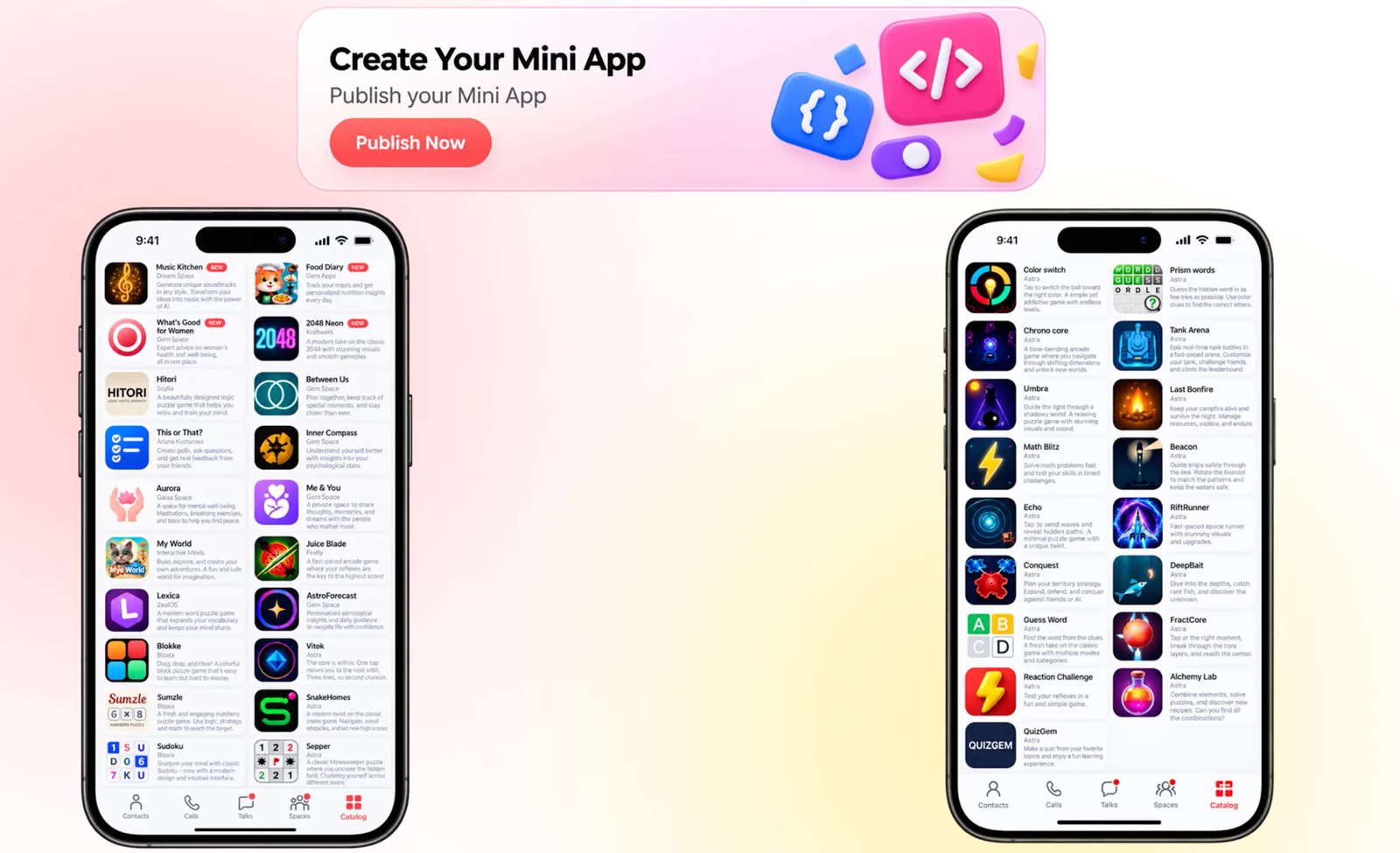
The mini-app ecosystem continues to accelerate. At the time of the conference there were 37 published mini-apps — up from 30 the previous Monday. The growth is coming from entirely independent developers who are approaching the platform on their own initiative.
The category mix has shifted significantly in recent weeks. While games still represent approximately two-thirds of the catalog, a wave of new categories has arrived. Current mini-apps include:
- Wheel of Inner State — a psychological tool exploring what holds the user back and what propels them forward in life.
- Together With You — relationship-focused psychological tests to help users improve their dynamic with a partner.
- Aurora and Health Checkup for Women — two mini-apps focused on women’s health.
- Astro Forecast — daily personalised forecasts based on the user’s name, date, time, and place of birth. The forecast updates every day. People pay for these, and they genuinely engage users on a recurring daily basis.
- Echo — a voting mini-app. Create a question, set two to five answer options or allow free text responses, post to a group, and collect fast answers. The democratic and practical use cases are immediately obvious.
- The World of Liy — a kitten character who tells stories, sings songs, and plays games with children aged two to five. Thoroughly engaging for young children and warmly received.
- Musical Forge — a mini-app where users can watch an artist forge songs in real time.
- Nutrition Diary — for users tracking diet, weight management, or nutritional goals.
- Between Us — a psychological test with support components.
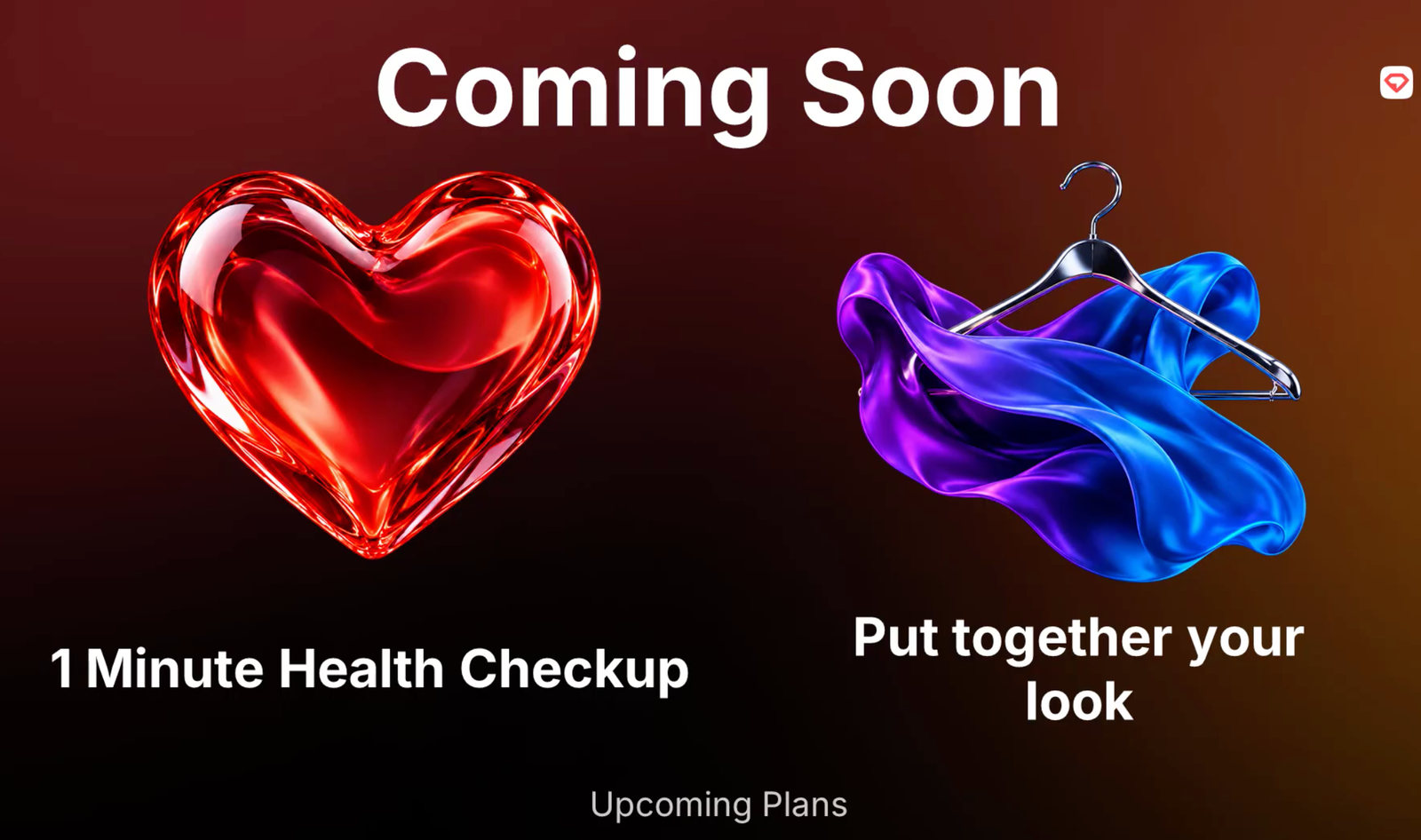
A mini-app catalog is coming in the September 29th release or shortly after — organizing apps into clearly defined sections by category: games, psychology, music, children’s content, health, and more. This will make discovery significantly easier for users who are not yet familiar with the ecosystem.
Sharing mini-apps is one of the most impactful actions any user or investor can take right now. Open any mini-app, tap the three-button menu at the top, select share, and a link is generated. Send it via any messenger or platform. A recipient who does not yet have Gem Space will download the app, register, and enter the mini-app directly — converting an external contact into a new Gem Space user.
Payments inside mini-apps are coming in October. Once live, developers will be able to charge for content, services, game advantages, paid channels, or any other offering within their mini-app. A developer who currently gives away their content for free will have the option to monetize it. New developers with commercial products will have a clear and simple path to bringing them to the platform. The earning potential for mini-app creators scales directly with the growth of the Gem Space user base.
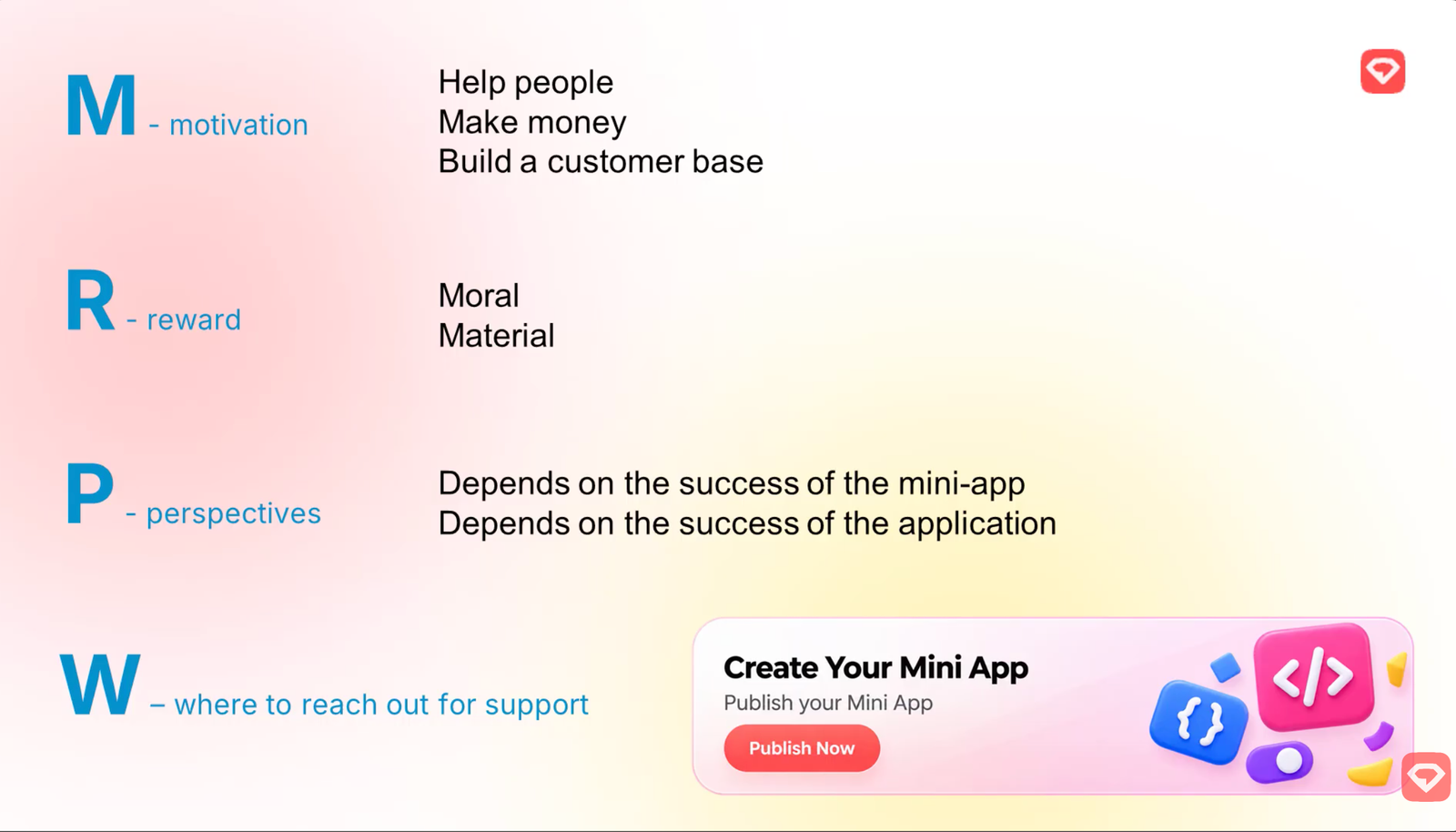
For anyone interested in creating a mini-app: open the mini-app catalog, click the “create your mini app” link at the top, and follow the guided chatbot process. No programming expertise required. The team supporting mini-app development is available for questions directly through the same interface.

Gem Premium: September 29th — Full Feature Breakdown
Gem Premium launches on September 29th. The first phase of the subscription includes:
— Guest access via link without requiring the guest to register on Gem Space, enabling external participants to join calls and meetings directly.
— Unlimited call duration, removing the time limit applied to free accounts.
— Up to 300 participants per call for large team meetings and assemblies.
— Full HD video quality for all call participants.
— Webinars supporting up to 1,000 participants.
— Unlimited voice message transcription, compared to one per day on free accounts.
— No file size restrictions.
— Control over who can send voice and video messages to the subscriber.
— Unlimited chat pinning — up to 50 chats, versus 10 on free accounts.
— Hidden online status and last seen time.
— Premium badge distinguishing subscribers from standard users.
Phase two will add status setting, restrictions on forwarding and copying, disappearing messages, screenshot restrictions, and reactions during calls. Phase three will add chat folders, polls within chats, chat translation, fully encrypted secret chats, and live animated avatars.
Stories are confirmed for development in Q4, with the expectation that the feature will reach users before the end of the year.
The PayGem Wallet: How It Works
A detailed explanation of the PayGem wallet was provided at the conference in response to investor questions.
The wallet functions as a standard digital wallet. Users can add money via bank card or bank transfer, see their balance in the relevant currency — rubles, euros, dollars, pounds, or others depending on supported currencies — and spend from the wallet on items within the application such as premium accounts or mini-apps. Cryptocurrency support including Bitcoin and USDT is planned for a later stage.
Income flows into the wallet as well. If a user sells something through a mini-app, provides paid services through a channel, or earns from any monetized activity on the platform, those earnings arrive in the wallet and can be withdrawn.
At launch on September 29th, the wallet will function primarily as a payment option for purchasing premium accounts. In the next stage, full wallet functionality — adding funds, spending from the wallet balance, and withdrawing — will be introduced.
The wallet is for all Gem Space users, not exclusively for investors. It is a tool for the broader user economy the platform is building.
The Global Economic Context: Building Every Day
The strategic portion of the September 21st briefing addressed a question investors have been raising with increasing frequency: given the global economic instability, AI bubble concerns, and geopolitical complexity, is the plan still viable?
The answer offered was grounded and direct. The crisis is not coming — it is already here. The NASDAQ is driven by companies spending $65 billion in capital expenditure while earning $6.5 billion in revenue. That gap of more than ten times has to be funded from somewhere, and the upcoming IPOs of major AI companies will draw in capital from funds and the middle class before the inevitable correction. This is not a theory — it follows the same pattern as the dot-com bubble of 2002 and the financial crisis of 2008. The technology itself will continue to develop. The economic model around it will change.
Gem Space’s position within this environment is deliberately different. The platform is not a public company. Its value does not depend on stock market indices or the performance of AI infrastructure companies. Its value depends on the number of users, the cash flow generated within the ecosystem, and the quality and range of services available on the platform. These are factors the team controls and actively develops every single day.
The strategy in this environment is not to wait for stability to return. That kind of stability — what was described at the conference as the “golden age” of predictable conditions — is not coming back. The strategy is to take daily steps forward. Develop the product. Launch monetization. Improve quality. Grow the user base. Build the fintech infrastructure. Enter new markets. Replace what is not working with what does. And keep moving.
Countries in the Middle East, specifically Qatar and Saudi Arabia, are where the regional sales teams have returned. Cloud service deployment in Qatar is underway — targeting not only enterprise licenses but also individual users. New countries including those in the Eastern Mediterranean are being engaged. The pipeline of deferred demand from the Gulf conflict period remains intact and is expected to convert as conditions stabilize.
The factors of success named at the conference: internal energy and collective belief in the project, high daily productivity from the team, the willingness to transform and adapt quickly, and a continuous impulse toward action rather than waiting. These are qualities that have sustained the project through ten years of difficulty and that are now being applied to the most consequential phase in its history.
Stay informed — join our Angels Team channel in Gem Space.
Comments are closed