
A lot has happened over the past weeks across both the technical and business sides of Gem Soft. This briefing covers the latest development updates for Gem Space and Gem Team, answers to key investor questions, and the strategic context behind the company’s continued push into the Middle East and beyond.
Gem Space: What’s New and What’s Coming
The March 5th release delivered over 70 improvements and fixes across all platforms — one of the more substantial updates in recent months. Work continues on the ongoing data migration from Google infrastructure to Gem Soft’s own solution. The process is progressing smoothly, monitored around the clock by the support and development teams. Chat and message data migration is now underway, with the overall volume of remaining data steadily decreasing.
A new release is scheduled for March 26th, bringing over 50 improvements — including significant enhancements based on feedback from the design team and users. Among the most notable changes is a redesigned navigation structure.
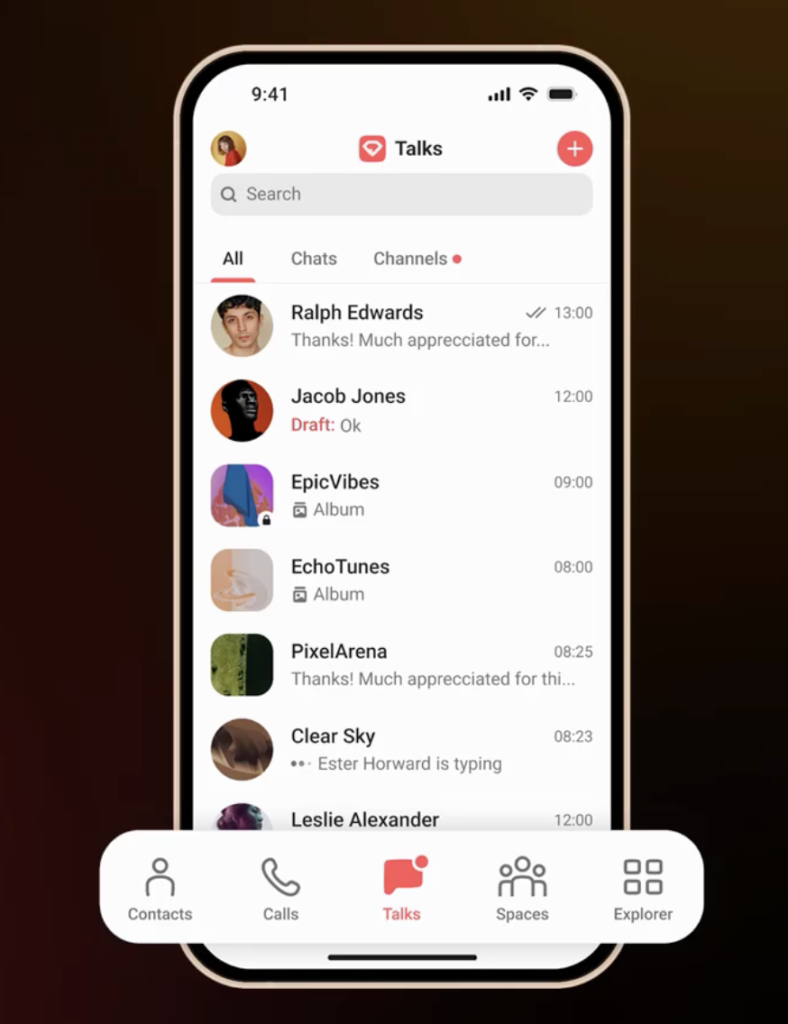
The bottom menu will now feature contacts, calls, communication, spaces, and a catalog — making the app immediately familiar to users arriving from WhatsApp, Telegram, or other platforms. The app will always open on the communication tab, with calls and contacts accessible directly from the main screen.
A new QR code contact-sharing feature will also be introduced — allowing users to share their profile, group chats, or channels instantly via a scannable code. And a new privacy setting will prevent unknown contacts from finding users by name, significantly reducing unwanted messages and spam.
On the backend, work is actively ongoing on an updated search service and bot infrastructure — both shared across B2B and B2C products. Given the anticipated influx of new users due to Telegram restrictions in Russia, improving search functionality has become a top priority to ensure new users can find each other quickly and easily.
The week of March 16th to 22nd already showed a sharp and visible increase in new Gem Space downloads — nearly double compared to previous weeks. As of this briefing, total installations have reached 50 million, with approximately 800,000 new users joining recently.
Gem Team: Three Products, One Platform
Gem Team has reached an important milestone with the release of version 2.1, which introduces a calendar feature — now available on web and iOS, with Android coming shortly. The calendar has been widely adopted by the development team internally and is considered a highly practical tool for business communication, meeting scheduling, and workflow coordination. The release also included over 30 additional fixes and improvements.
The next release, version 2.1.1, will focus on stabilization and further calendar refinements. A major April release is in preparation, which will introduce P2P encryption between clients — one of the most significant competitive differentiators the platform will offer.
Alongside individual product releases, a broader structural development is underway. The Gem Team product line now consists of three distinct offerings built on the same core platform.
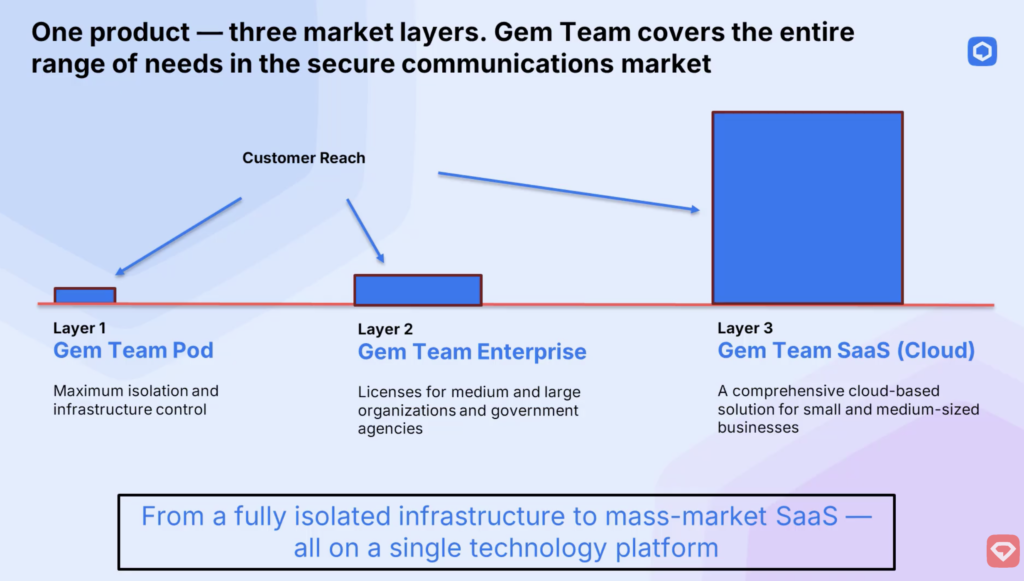
Gem Team Pod is a portable, single-server solution designed for organizations requiring the highest level of physical security — family offices, investment firms, and operations in remote or sensitive environments. It is essentially a military-grade deployment option.
Gem Team Enterprise is the existing flagship solution for medium and large organizations, deployed on the client’s own infrastructure. The first two licenses have been sold, with the second license acquired in December. Both clients are satisfied, and renewals are expected. Work on a third license is actively underway.
Gem Team Cloud is the newest addition — a subscription-based, cloud-delivered solution for small and medium-sized companies that need enterprise-grade security without the cost or complexity of on-premise deployment. Each client receives a completely isolated digital environment within the shared infrastructure. No integration is required — companies simply sign up, pay, and start using it. The analogy used internally is that of a high-rise building: one structure, hundreds of fully isolated apartments. This solution is expected to expand the addressable market by tens or even hundreds of times. It is scheduled for readiness by the end of May.
Middle East: Pushing Forward Through the Turbulence
The events of recent weeks in the Middle East have created friction in some areas — but have simultaneously accelerated demand for exactly what Gem Soft offers. Following the conclusion of Islamic holidays, the team is returning to the region, with presence in both Qatar and Saudi Arabia.
All previously scheduled demo version tests are continuing as planned. Technical teams remain in active contact with clients in the region, and no negotiations have been cancelled. On the contrary, the security shocks experienced across the Gulf have pushed governments and organizations to think more urgently about sovereign communication — and to seek solutions they can deploy on their own infrastructure, under their own control.
Gem Soft is positioned as a neutral provider, offering full technology transfer — source code, local deployment, training, and ongoing support. This is something no major global technology platform is willing to provide. The demand is real, and the pipeline is growing.
A VIP club meeting will be held in the coming weeks to provide detailed on-the-ground updates following the team’s return to the region.
Key Questions Answered
Several important investor questions were addressed during the briefing.
On the topic of Gem Team Cloud, the platform’s architecture ensures full isolation between clients despite shared infrastructure — comparable in principle to how companies like Microsoft, Salesforce, Zoom, and Slack deliver subscription-based software to millions of customers globally. These companies generate billions in recurring revenue through this model. Gem Soft is building toward the same structure.
On mini apps and class A shares — mini apps are classified under class A shares, as they relate directly to the main Gem Space application. As mini app creators generate revenue on the platform, Gem Space takes its commission, benefiting all class A shareholders.
On business continuity — the fund operates a distributed financial system with multiple mirrors and access routes. Shareholders will always have access to the business center and shareholder cabinet regardless of regional internet disruptions. The fund is regulated by the Financial Services Commission of Mauritius, and shareholder rights are protected under that jurisdiction.
On the current class A share count — investors currently hold 17,887,860 class A shares, with 2,260,349 remaining.
On the audit valuation and discounts applied — auditors currently apply discounts because Gem Space does not yet have built-in monetization. Once PayGem and the mini-app engine launch in spring, monetization will be established, and the basis for valuation will shift significantly upward.
The Bigger Picture
The pattern being observed today mirrors what happened during the 2008 to 2009 financial crisis. While institutions collapsed and markets fell, companies like Uber, Airbnb, WhatsApp, Slack, and Pinterest were being founded — and the investors who backed them during the turbulence were the ones who ultimately captured the most significant returns.
Gem Space and Gem Team are infrastructure products for an era defined by the need for security, sovereignty, and independence. The demand is not speculative — it is structural and growing. Crises do not eliminate this demand. They accelerate it.
Stay informed — join our Angels Team channel in Gem Space.
Comments are closed