Following the product team’s briefing, board members Valeriy Ostrikov and Alexander Kachanovskiy addressed shareholder questions and shared strategic updates on the company’s direction, regional sales, and the broader geopolitical context shaping demand for the platform.
Crypto and Fintech: Regulatory Clarity in Russia and CIS
Valeriy Ostrikov addressed concerns around the regulatory environment for cryptocurrency in Russia, specifically regarding the Whitebird integration announced as part of Gem Balance.
The Russian government and central bank have finalized a draft law on digital currency that brings crypto operations into the legal framework. The core principle is that exchanges between digital assets and rubles must be conducted through regulated channels — everything outside of that is considered illegal. Whitebird operates within these legal requirements, including in the Russian Federation. Users who are approved through Whitebird can continue operating without disruption. In parallel, the team is progressing with the PayGem Wallet integration as an additional channel.
Geopolitical Turbulence: Business Continuity in the Gulf Region
Ostrikov spoke directly to shareholder concerns about the security situation in the Persian Gulf and its potential impact on Gem Space operations.
The team anticipated that regional instability would not critically affect the business. During Ramadan, Gem Space employees who had been working in Qatar and Saudi Arabia temporarily relocated to the United States and England, with plans to return after the situation stabilizes. All technical work continues remotely, servers remain deployed in the Gulf, and cloud infrastructure operates globally. Two Gem Team demos were scheduled to proceed during this period.
Ostrikov highlighted several ways the situation has worked in the company’s favor. Remote work has proven efficient for teams interacting with external partners. More significantly, the disruption of internet access across Iran — which cut off the population from all external communication platforms — has accelerated thinking among governments and corporations about the strategic value of locally controlled communication infrastructure. Partners who signed agreements at Web Summit Qatar are now actively exploring protected internal communication systems that cannot be shut down by external actors. This is precisely the problem Gem Space is built to solve.
The Case for Sovereign Messaging: Why Countries Need Their Own Platform
Alexander Kachanovskiy presented a detailed explanation of what differentiates Gem Space from global messaging platforms — and why the distinction matters to governments.
Global messengers such as WhatsApp, Telegram, WeChat, and Signal share a common structural characteristic: a single, indivisible infrastructure controlled from a central headquarters, with data stored outside the jurisdiction of most countries. No country can localize the architecture, change the management model, or achieve technological independence from these platforms.
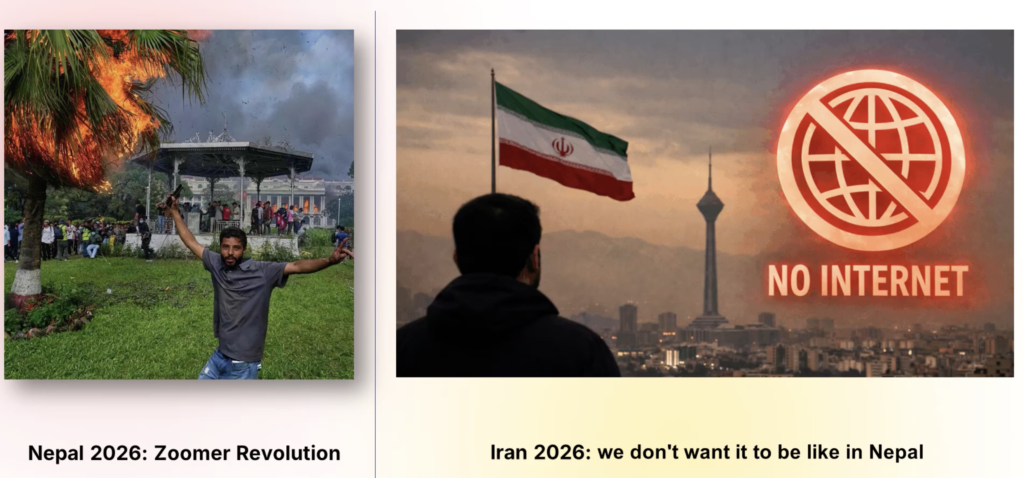
The consequences of this have become visible. During unrest in Nepal in 2025, the government shut down WhatsApp, Zoom, and YouTube — but this escalated protests rather than containing them. When access was restored, information spread uncontrolled, contributing to serious civil disorder. Iran, facing similar concerns, chose to shut down the entire national internet rather than risk losing control of communications on external platforms.
Gem Space offers a fundamentally different model. Each deployment is a fully sovereign, self-contained instance running on the purchasing country’s own servers, with no connection to global infrastructure such as Google Cloud, AWS, Azure, or any other external service. The country owns its data, controls administration and moderation, and operates entirely within its own legal framework.
From the outside, users simply see a national messenger — with any design, language, branding, or flag the country chooses. The underlying origin of the technology remains invisible. Each country, in effect, receives its own turnkey sovereign communication platform with the full functionality of a modern super app.
For Class A shareholders, each regional sale either generates a one-time income or produces recurring licensing revenue on 1-, 3-, or 5-year renewal cycles.
Regional Sales: Negotiations Underway
Kachanovskiy confirmed that negotiations for regional sales are actively ongoing, though the specific country under discussion cannot be disclosed at this stage.
On the question of exit strategy, he reiterated that the primary path remains a global sale to a strategic investor. A licensing model generating steady recurring revenue is the secondary option. An IPO is the third scenario and the least likely in the near term. The board’s focus remains on the first two.
Gem Team as Recurring Infrastructure
Kachanovskiy closed by framing Gem Team within the broader context of the software-as-a-service model. A sovereign communication platform is shifting from a discretionary purchase to a mandatory infrastructure requirement — particularly as governments and major corporations recognize that reliance on external messaging platforms represents a genuine strategic vulnerability.
The licensing model — where the product is rented rather than sold outright — generates annual recurring revenue with high margins and predictable cash flow. Each additional license sold scales revenue without proportional increases in development cost. The product is built once; the market grows around it.
Current geopolitical conditions are compressing timelines. The team is working to accelerate the sales cycle, and the first license has already been executed in Central Asia. The view from the board is that the initial phase of sales always takes time to build momentum — but the underlying demand is structural and growing.
The next board conference will include further updates on regional negotiations, download growth strategy, and the roadmap for PayGem mini apps and the Statuses feature. Shareholders are encouraged to submit questions in advance through the support service.
Comments are closed