
Gem Space B2C: What Just Shipped and What’s Coming
On April 27th, a stabilization release was deployed across all platforms — server, iOS, Android, and web — with over 50 different improvements and fixes. While relatively modest in scope, it was deliberately designed as preparation for the much larger releases ahead. Among the improvements were increased notification sound volume, fixed chat list displays across platforms, an updated catalog screen design on iOS, improved voice message recording quality on Android, and an enhanced message input field on the web.
Two major releases are now on the calendar — May 28th and June 9th. These are substantial updates that will bring a large number of new features and improvements, including the continued removal of data from Google Cloud. The June 9th release in particular marks a significant architectural transition — three new core services will launch, representing the beginning of Gem Space’s move from a monolithic architecture to a microservices architecture. This is a foundational shift that will benefit both the B2C and B2B products going forward.
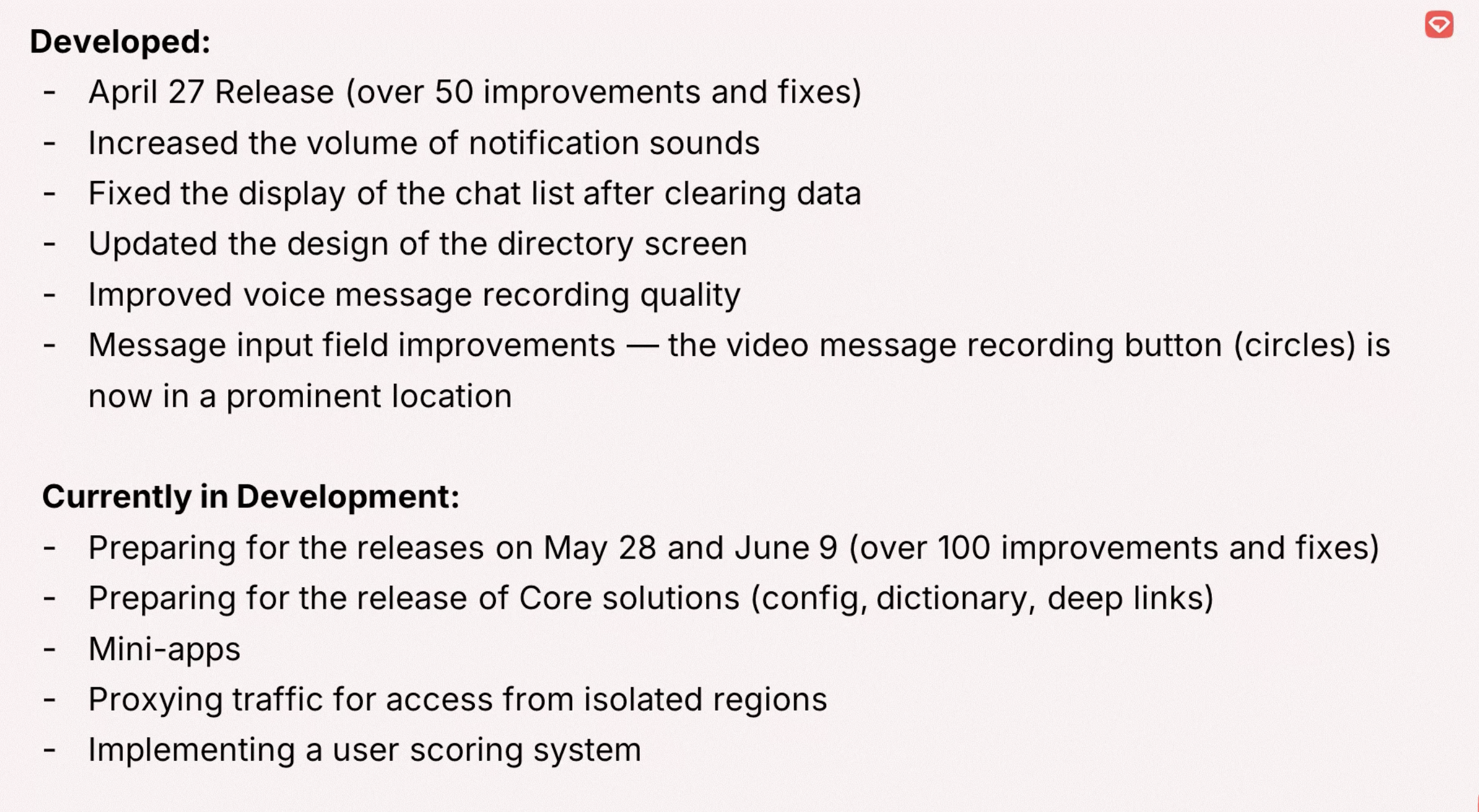
Work on the mini-app platform is actively underway. The development team has begun building the engine itself, and on the client side, a bridge mini-app is being developed — a special API interface that will allow third-party developers to build and promote their own solutions within the Gem Space ecosystem. This is the technical foundation that will eventually allow hundreds of thousands of external developers and companies to reach Gem Space users directly.
Another significant development currently in progress is traffic proxying. The team has encountered restrictions on the availability of the application in various regions. To address this, both the infrastructure and client teams are working on a solution that will proxy traffic through the company’s own servers and virtual machines, routing it to any region in the world depending on where the proxy machine is located. This will significantly reduce vulnerability to regional blocks and access restrictions.
The user scoring system — designed to combat fraud, spam, and malicious behavior — is scheduled for release on May 28th. Each registered user is assigned a points score. As users engage in undesirable actions — sending mass identical messages, creating chats with unknown users, and similar spam behavior — points are deducted. Once a user falls below a certain threshold, they are temporarily blocked. If the behavior continues, the blocking duration increases, eventually leading to a permanent ban. The system is mathematically precise and has been designed carefully so that legitimate users are not affected.
On June 9th, all message data — everything users have written over the years of using the application — will be migrated from Google Cloud to the company’s own storage. This data totals several terabytes and is the most sensitive and voluminous of all data types. Once complete, Gem Space will be fully transitioned to its own controlled servers, eliminating reliance on Google systems entirely. This is especially important given that some corporate solutions are now being blocked in certain regions, making independence from external infrastructure a strategic necessity.
Gem Team B2B: Version 3.0 Is Coming
Version 2.1.1 was released on April 21st — a relatively minor stabilization update with over 50 improvements and fixes across all platforms, including improvements to the calling system and integration between old and new platform solutions. Most of the B2B development team is currently focused on the upcoming 3.0 release, which is why the version number jumps significantly — a major version increase signals that fundamental functional changes are being introduced.
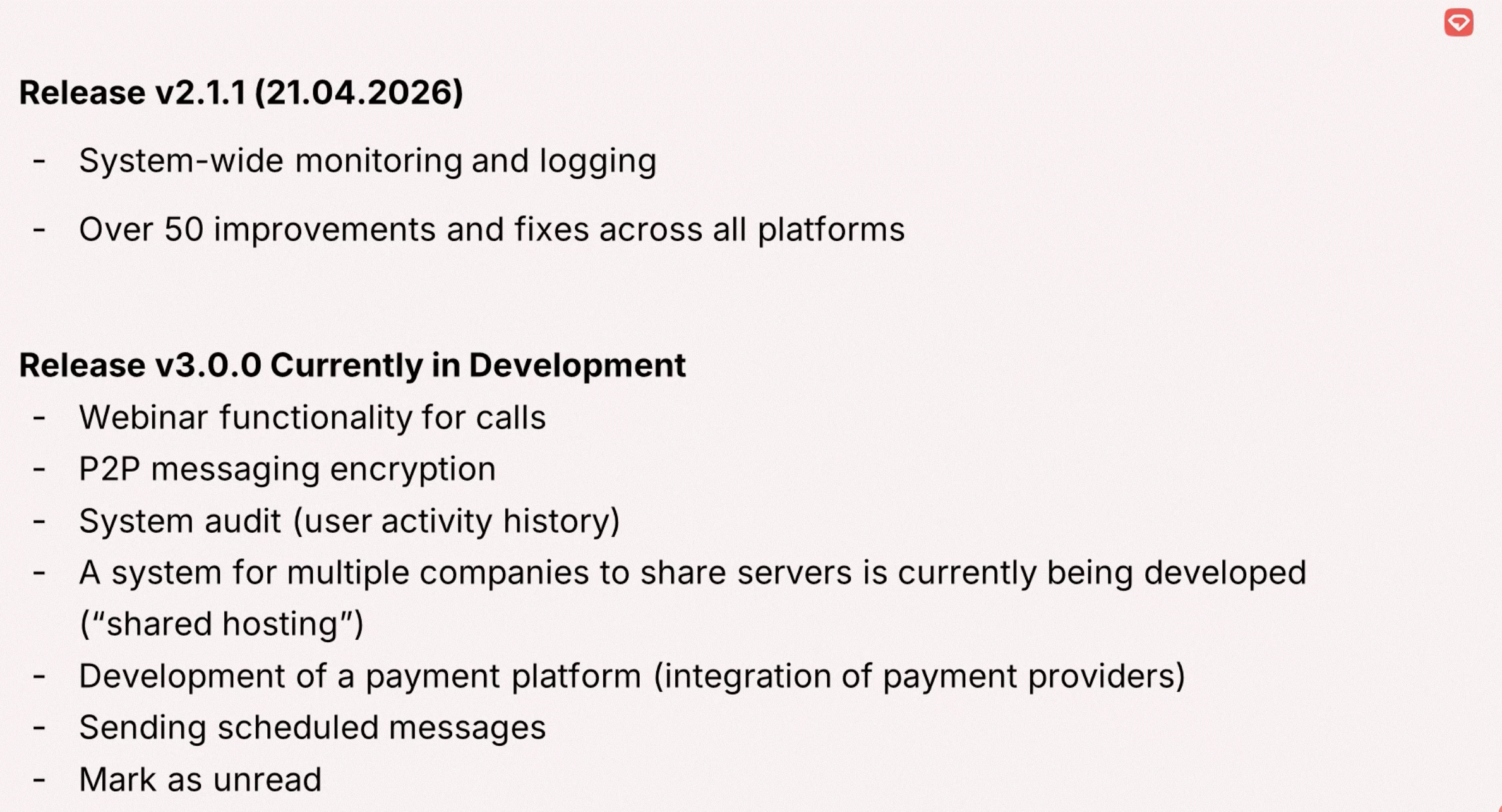
The 3.0 release is planned for the beginning of next month and will include several long-awaited features.
Webinar functionality is being introduced for calls — a highly anticipated feature. This includes participant role management, with roles assigned as moderator, speaker, or listener, and corresponding rights restrictions per role. This will allow Gem Team to support structured large-group meetings directly within the platform.
End-to-end P2P encryption for messaging is also arriving in this release. This is a client-side encryption system, meaning a third party cannot decrypt messages without direct physical access to the device and the encryption key. The implementation uses tested protocols with a very high level of encryption and protection.
System auditing, call history, user history, and related back-office improvements continue to be developed — all critical for enterprise clients who need full visibility and accountability within their deployments.
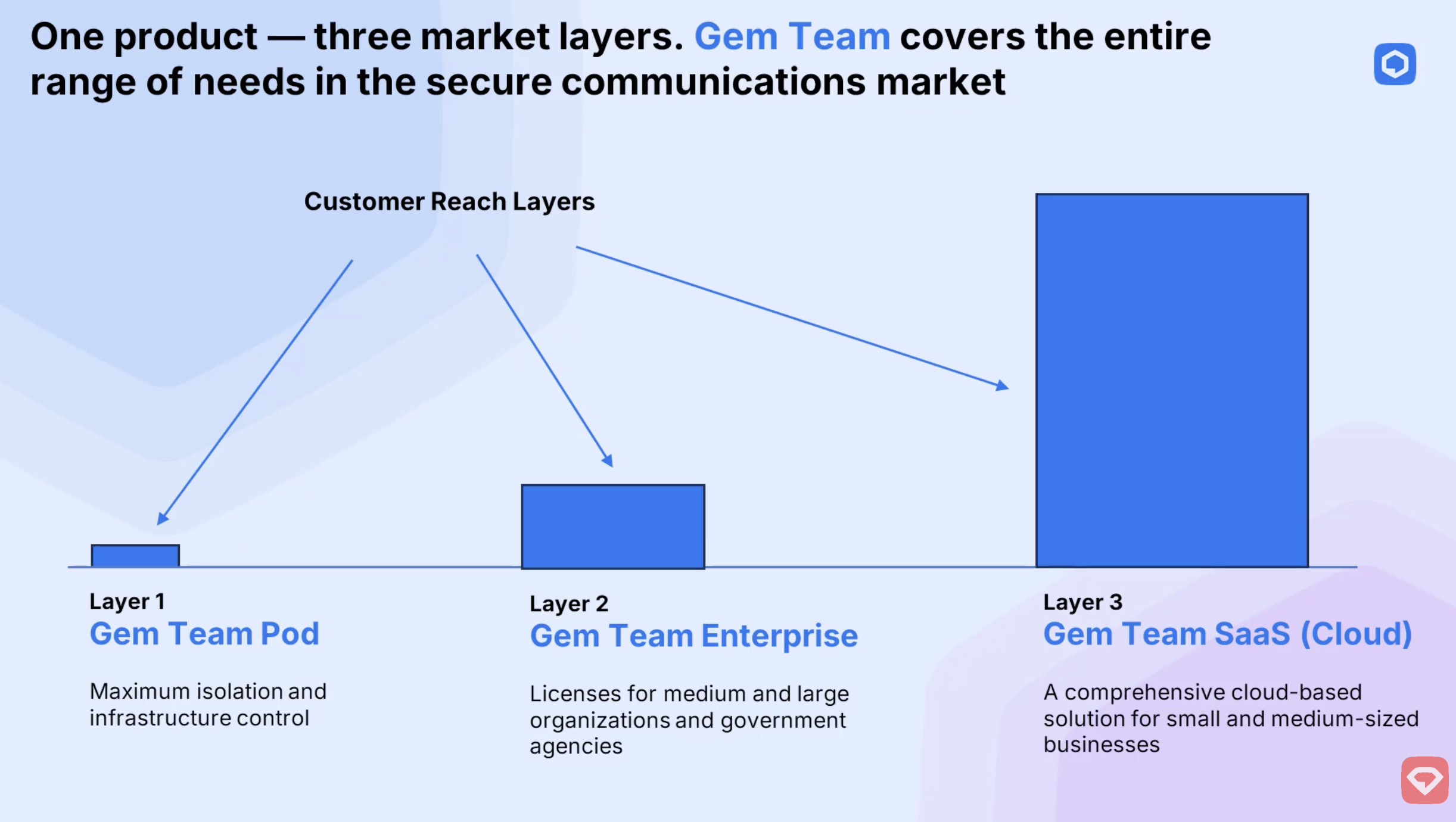
The communal cloud system — which allows multiple companies to coexist on shared server infrastructure while remaining fully isolated from one another — is also in development. This is the technical foundation for Gem Team Cloud, the mass-market product targeting small and medium-sized businesses.
Within the cloud system, a payment platform is being built that will allow licenses to be sold directly from within the application. Integration with a payment provider — currently Cloud Payments — is being implemented, with the architecture designed to support different providers for different regions from the outset. This flexibility ensures the platform works across varied financial infrastructure worldwide.
Delayed message sending is also being included in the 3.0 release — a small but frequently useful feature that forms the foundation for broader scheduled functionality in future releases.
The 3.0 release effectively changes Gem Team’s position in the market. It is a transformative update.
How the Development Team Is Structured
A question submitted by investors prompted a detailed explanation of how the development team is organized internally.
The full development team is currently divided into five groups, each covering all platforms — iOS, Android, web, server, testing, and infrastructure.
Two teams focus on B2B. The first handles back-office development and integration of third-party systems into the B2B product. The second develops the core calling solution — which is shared between both B2B and B2C products — and is therefore split across both directions.
Three teams work on Gem Space. The first team is dedicated to migrating away from Google infrastructure and transferring all data to the company’s own servers. The second team works on the core architectural transformation from monolithic to microservices architecture. The third team is the product development team, currently focused on the mini-app engine and new feature development.
Each team works in parallel, which is what allows large volumes of updates and releases to ship across multiple products simultaneously.
Key Investor Questions Answered
Several important questions were addressed at the briefing.
On the timeline for negotiations — active negotiations are genuinely ongoing simultaneously with multiple entities. The reason no specific timeline can be given is not evasiveness — it is the nature of these deals. Pricing negotiations sometimes do not align. Document preparation and review takes significant time. Counterparties conduct sanctions checks on the company and its representatives. Each deal involves multiple stages and none of them move on a predictable timeline.
On why the Middle East is the primary focus rather than larger population markets like Indonesia, India, or Brazil — the answer comes down to two factors: solvency and urgency. The same product can be priced three times higher in the Middle East than in a country like Indonesia — because local purchasing power determines what companies can actually afford to pay. Middle Eastern countries are not only significantly more solvent, but they also have a much more urgent need to achieve sovereignty and independence from global technology platforms. The events of recent months have accelerated that urgency dramatically. Once the company succeeds in these markets, it will be considerably easier to enter larger but lower-priced markets at adjusted price points, achieving equivalent revenue through volume.
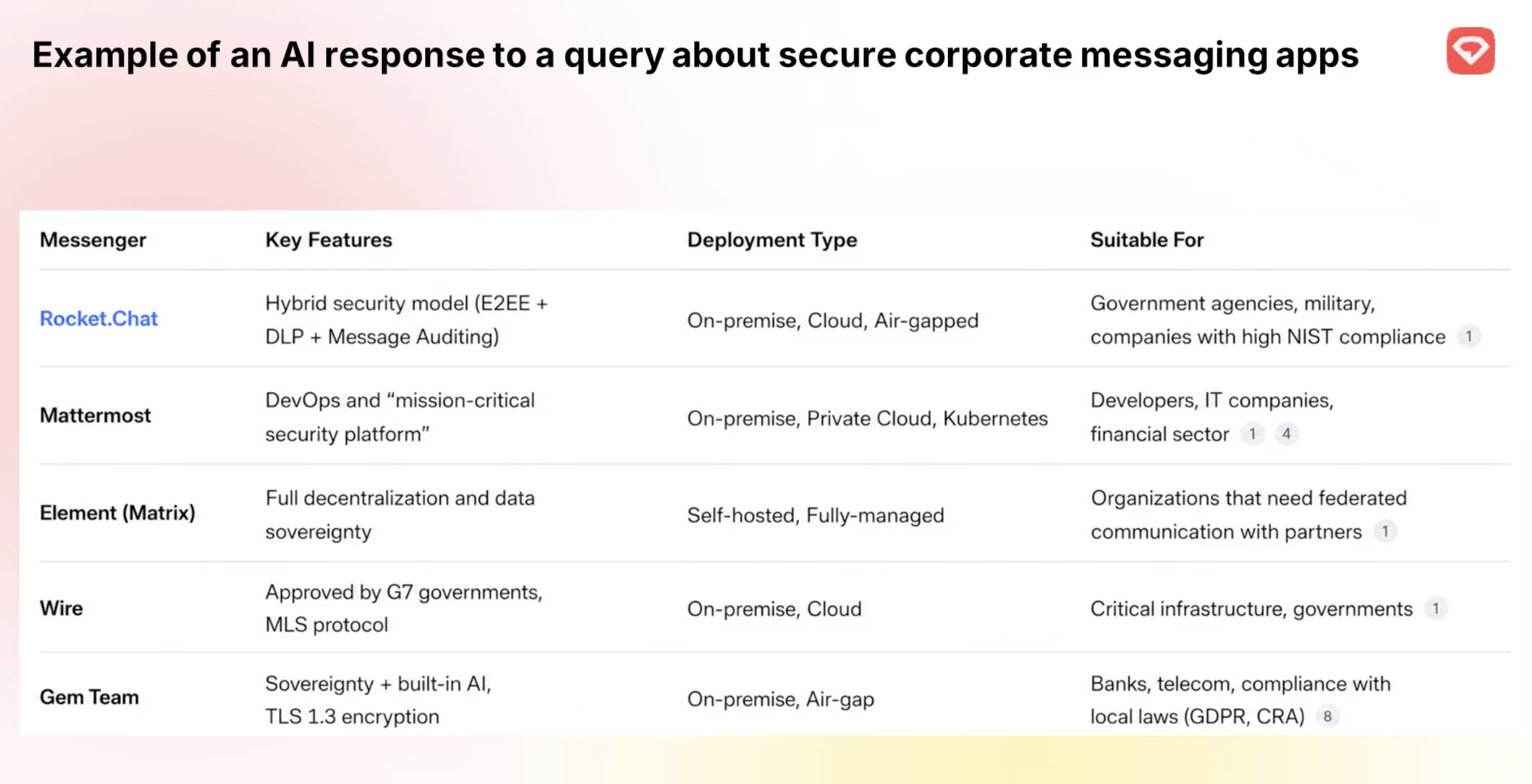
On where Gem Team stands competitively — the question raised was that a Google search returned 14 secure corporate messengers without listing Gem Team. The response addressed this directly and in detail. When reviewed properly, the competitive landscape looks quite different. Rocket Chat primarily serves the government and military sector — a highly closed niche. Mattermost targets developers and IT companies — also a narrow niche. Element serves organizations requiring federated communication across global subsidiaries. Wire is used predominantly by European government agencies.
None of these are targeting the same market as Gem Team. Gem Team is built for banks, telecoms, and medium to large companies in the range of 1,000 to 50,000 employees — the largest addressable segment in the corporate secure communications market, and the one where an affordable, full-featured, sovereign platform has the clearest competitive advantage. When asked directly, AI tools including ChatGPT rank Gem Team among the top five corporate messenger ecosystems available today, citing its full platform architecture and sovereign deployment capability as key differentiators.
On dividend eligibility for Gem Team Cloud — dividends from Gem Team Cloud will be paid on class C shares, as this is a Gem Team product. All three tiers of Gem Team — Cloud, Enterprise, and Pod — fall under the same class C share structure.
On licensing models for white label Gem Space — both perpetual and fixed-term licensing models are being offered and negotiated. A perpetual license is priced significantly higher as it covers unlimited use in perpetuity. Fixed-term licenses are smaller annual amounts that renew each year. In both cases, the core of the product is necessarily installed on the client’s own servers — that is a technical requirement for the platform to function as a sovereign messenger. Technical support and the cost of developing new features are negotiated separately in all cases.
On class C shares — sales will end on June 1st. No exceptions will be made after that date. As of the briefing date, just over 19,000 shares remained, with approximately 12,000 to 13,000 having been sold in the preceding week.
The Economy of the Future — and Why This Project Is Built for It
The closing segment of the briefing addressed the broader strategic context — why continuous adaptation is not optional, and why the platform Gem Soft has built is positioned correctly for the economic order that is emerging.
The new economy is defined by control over flows — flows of information, money, and data. Not oil or gas. The companies that control these flows in the next economic era will be the most valuable entities in existence. The platform Gem Soft has built is a direct expression of this model — a system that connects large numbers of people, enables new forms of commerce and exchange, and generates value that grows with every user who joins.
The team has been building continuously for ten years. The architecture is designed to respond quickly to change. The product is present and established in one of the most strategically important regions for technology sales in the world. The economic shifts occurring globally — the collapse of old models, the rise of automation, the urgent demand for sovereignty and independence in digital infrastructure — are all accelerating demand for exactly what Gem Soft offers.
As the conference concluded — the company is not alone in this market. But it is hungry, determined, and backed by a community of over 50,000 investors across 70 countries. The share of the market it is building toward will be claimed.
Stay informed — join our Angels Team channel in Gem Space.
Comments are closed