
The Numbers First — and They’re Remarkable
Every briefing starts with numbers, and this month’s numbers are worth paying close attention to.
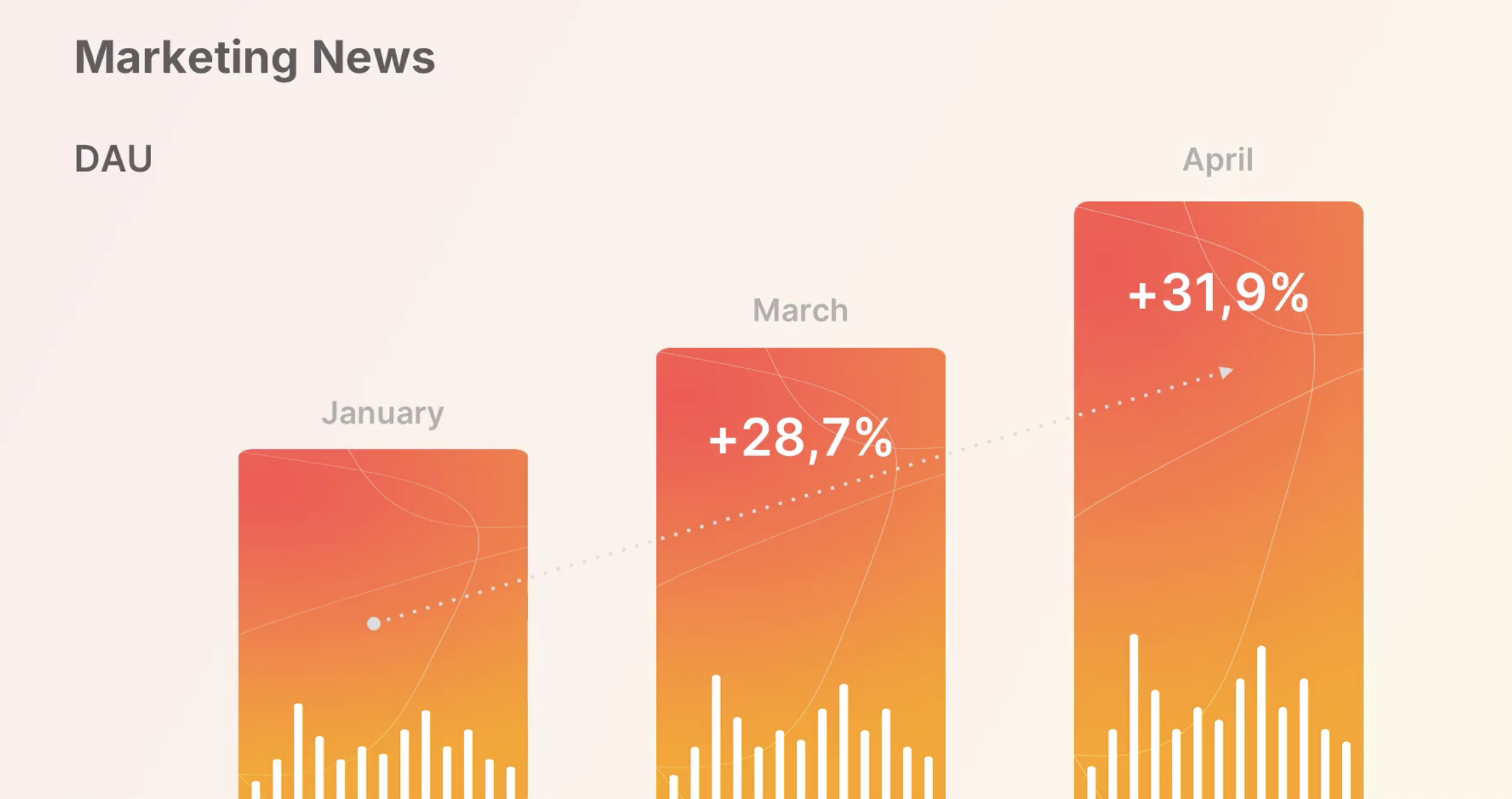
Daily active users in April grew by nearly 32% compared to March. Monthly active users rose by 15.6% over the same period.
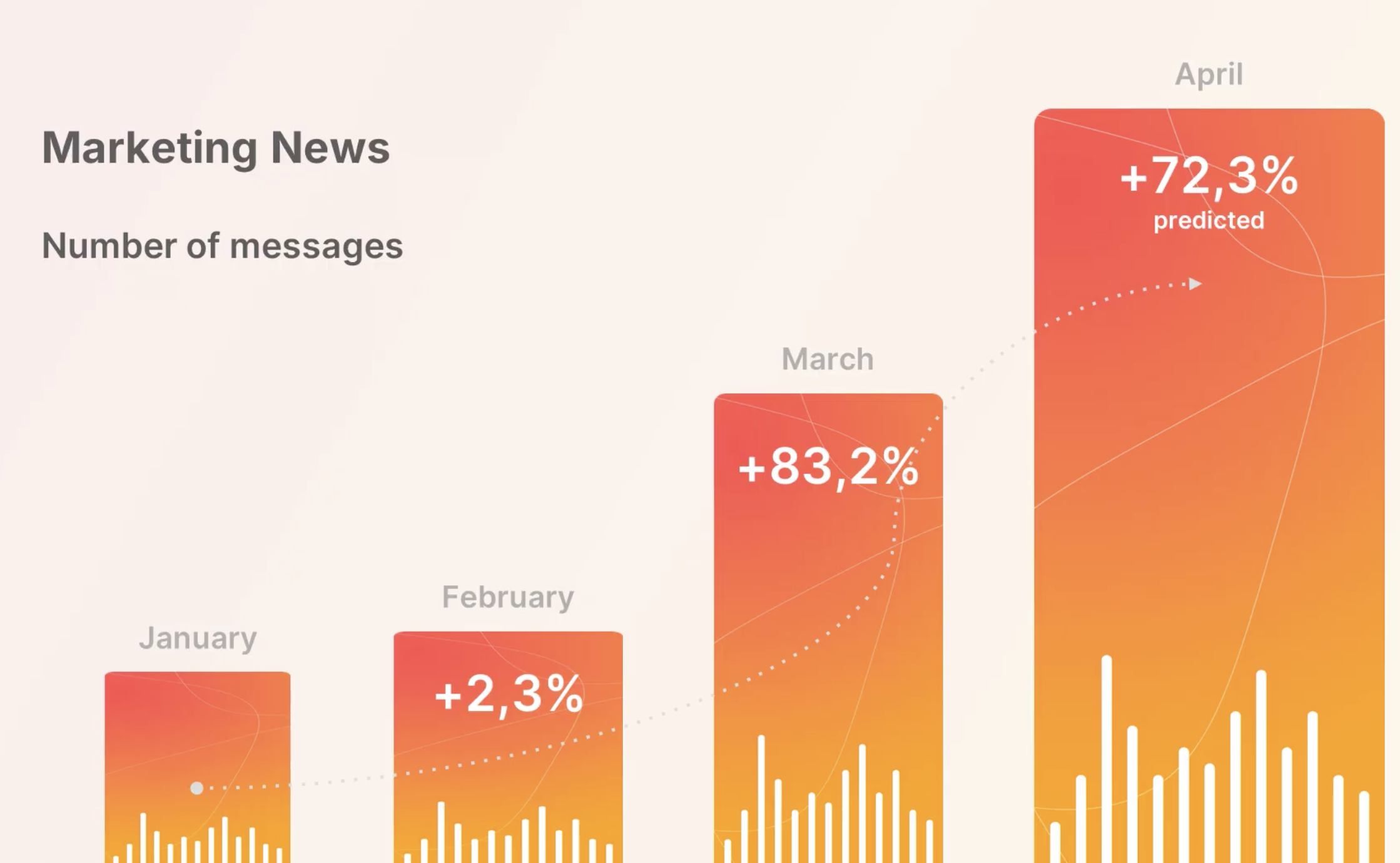
But the figure that really stands out is message volume — messages sent by users jumped 72% in April, on top of an already strong 83% growth in March. Put simply, people are not just downloading Gem Space — they are using it, coming back to it, and making it part of their daily communication.
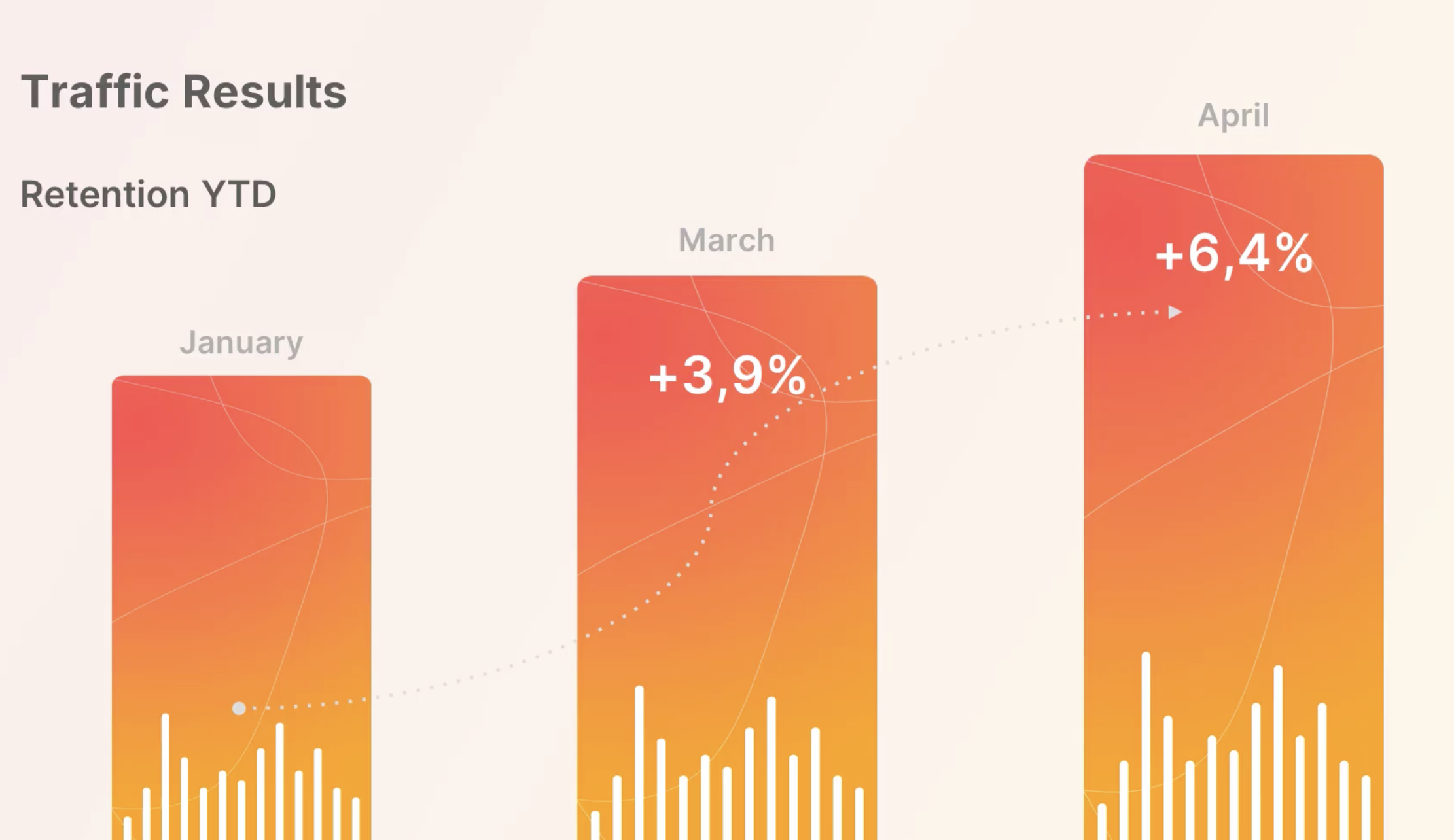
Retention improved by 6.4% as well, confirming that users who try the app are increasingly choosing to stay.
A significant portion of this growth is connected to the Russian market, where certain platform restrictions have driven users toward alternatives. But the trend is broad and the momentum is real.
What’s Shipping Soon
A major release is coming imminently, and it covers a wide range of improvements across the app.
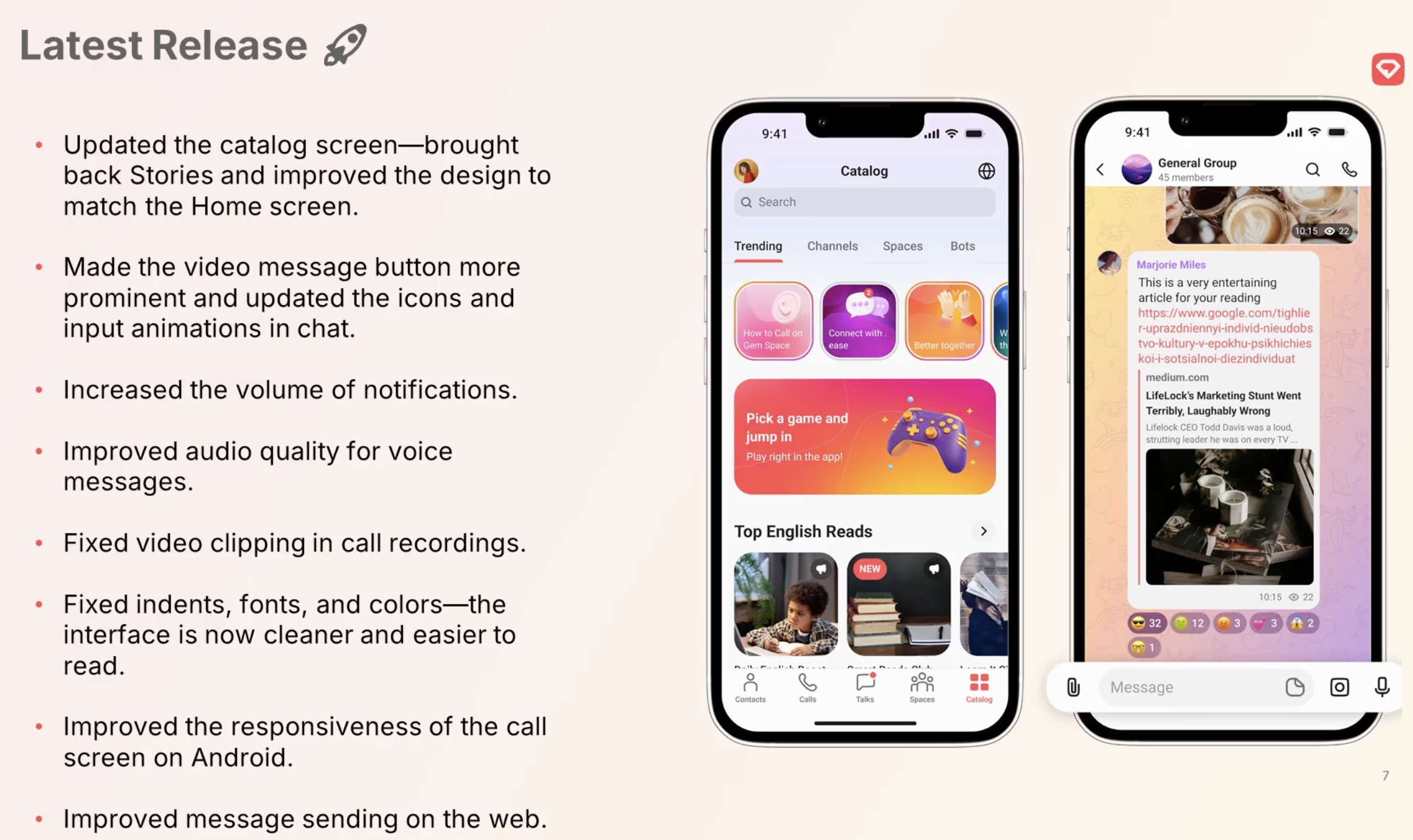
The catalog screen is being refined with stories that surface useful content for users, and the aesthetics have been brought closer to the feel of the main screen. One of the more visible changes is a redesigned message input field — with smoother animations and a more prominent video message recording button. The goal is to make that feature more discoverable and used more frequently.
Several things that users have flagged directly are being addressed in this release. Notification volume is being increased. Voice message sound quality is improving, which also means better accuracy for the voice-to-text transcription feature. A long-standing bug with video trimming in call recordings is fixed. The overall interface has been cleaned up — spacing, fonts, and colors — making it more comfortable to read and navigate. Android users get a smoother call screen, and web users get a more reliable message sending experience.
What’s Coming in May and June
Looking a little further ahead, several features that have been in development for a while are now approaching release.
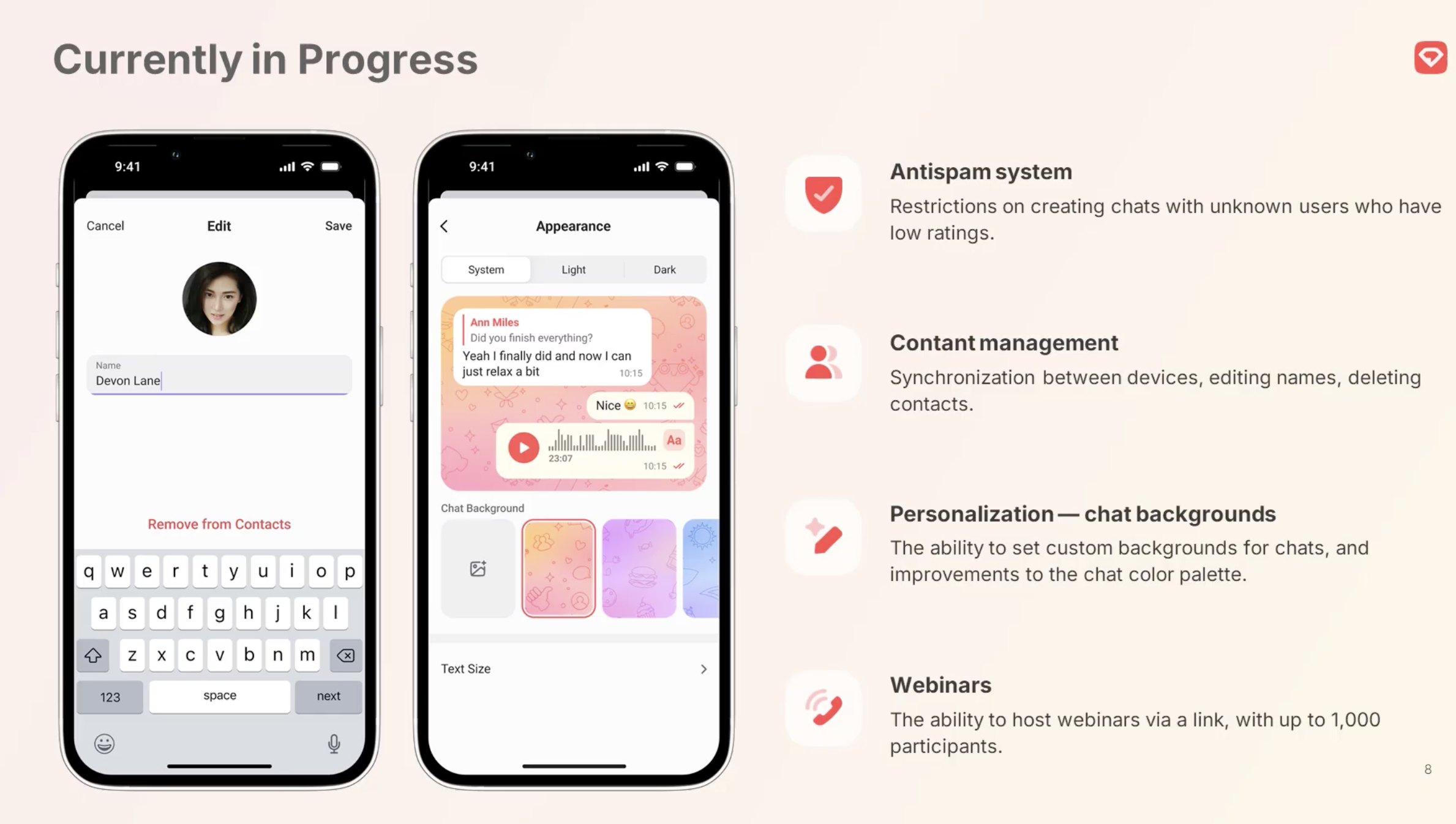
- The anti-spam system is one of the most anticipated. As the platform grows, it inevitably attracts bad actors — spammers creating mass chats, sending identical messages, and targeting users through group channels. The new system introduces a user rating that automatically detects and responds to this kind of behavior, progressively restricting what spamming accounts can do. Legitimate users will not be affected — this has been carefully accounted for. The system is targeting a release at the end of May.
- Contact management is getting a meaningful upgrade — better cross-device synchronization so users can easily see which of their contacts are already on Gem Space, the ability to rename contacts as preferred, and the ability to delete contacts entirely. This is coming in May to June.
- Chat customization is also in development. Users will be able to set individual backgrounds per chat, uploading their own images. The color palette of the chat interface is also being refreshed to feel more modern. This is expected in June.
- And the webinar feature — something the company has discussed for some time — is finally being prepared for a May release. It will support up to a thousand participants simultaneously, joinable via link, and will essentially bring the kind of weekly briefing format the company already runs into the hands of every Gem Space user.
The Big One: Premium Subscriptions Are Coming
The most strategically significant announcement in this briefing is the introduction of a premium subscription model — the first formal step in monetizing the Gem Space platform.
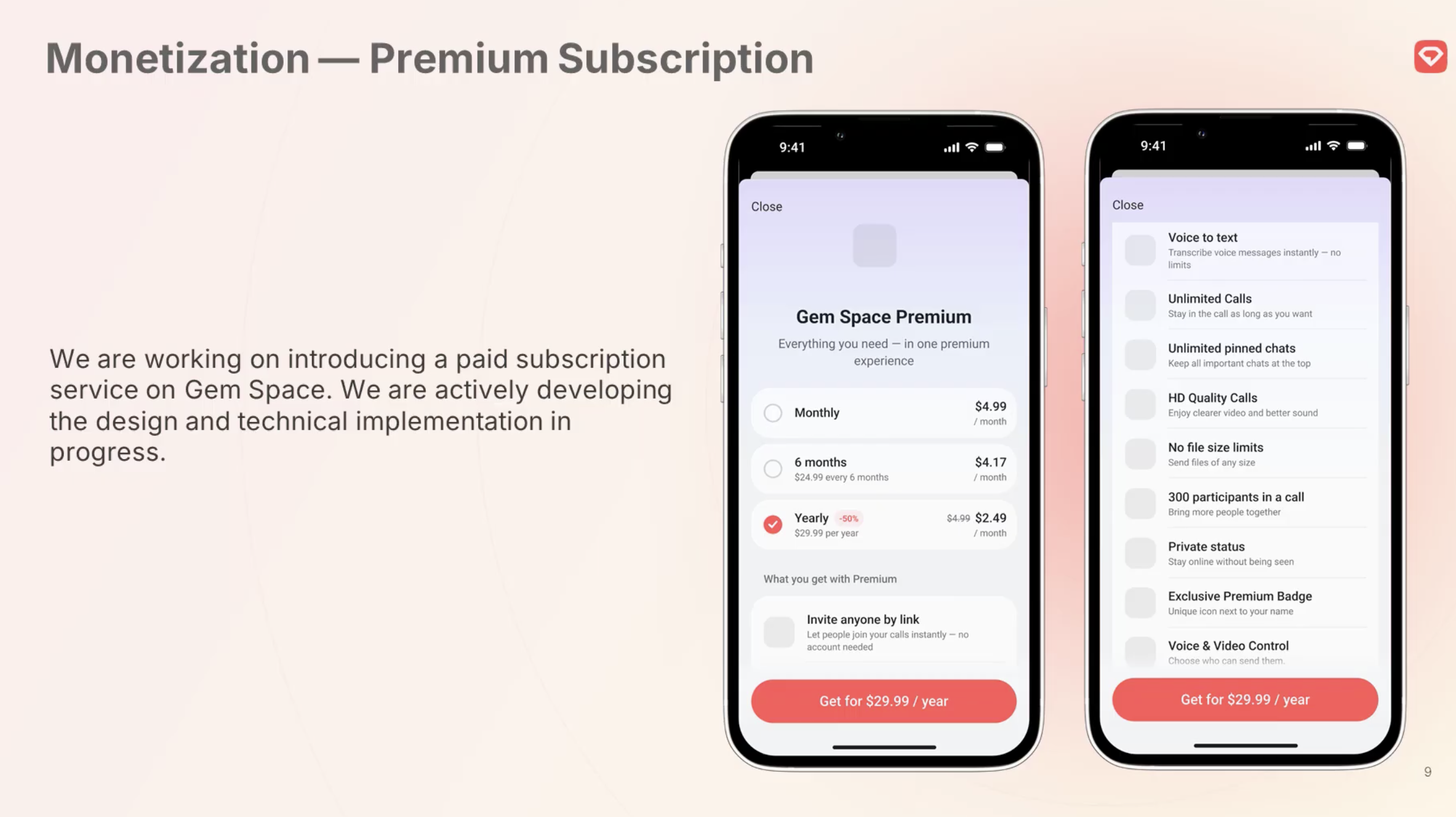
To be clear, the free version is not going anywhere. The subscription tier adds additional capabilities on top of it for users who want more. The reasoning is straightforward — the data shows that the core demand on the platform is messaging and calls. So the first monetization step is to meet that demand with a premium layer.
The initial premium features include improved video call quality, the ability to create calls via shareable links that anyone can join without registration, higher participant limits on calls, a premium badge in the profile, and voice message transcription. These are features that are already built and will be the first to roll out under the premium tier.
The second phase will introduce features designed specifically with the subscription model in mind — some will be premium-only, others will stay free. The design and architecture are actively being worked on, and the full implementation is planned for the coming quarters.
Gem Team B2B: A Solid Release and Significant Progress
On the B2B side, a substantial update was released for Gem Team — over 100 tasks focused on stability, quality, and user experience improvements. Beyond the fixes, the release introduced several administrator features that matter in real corporate environments.
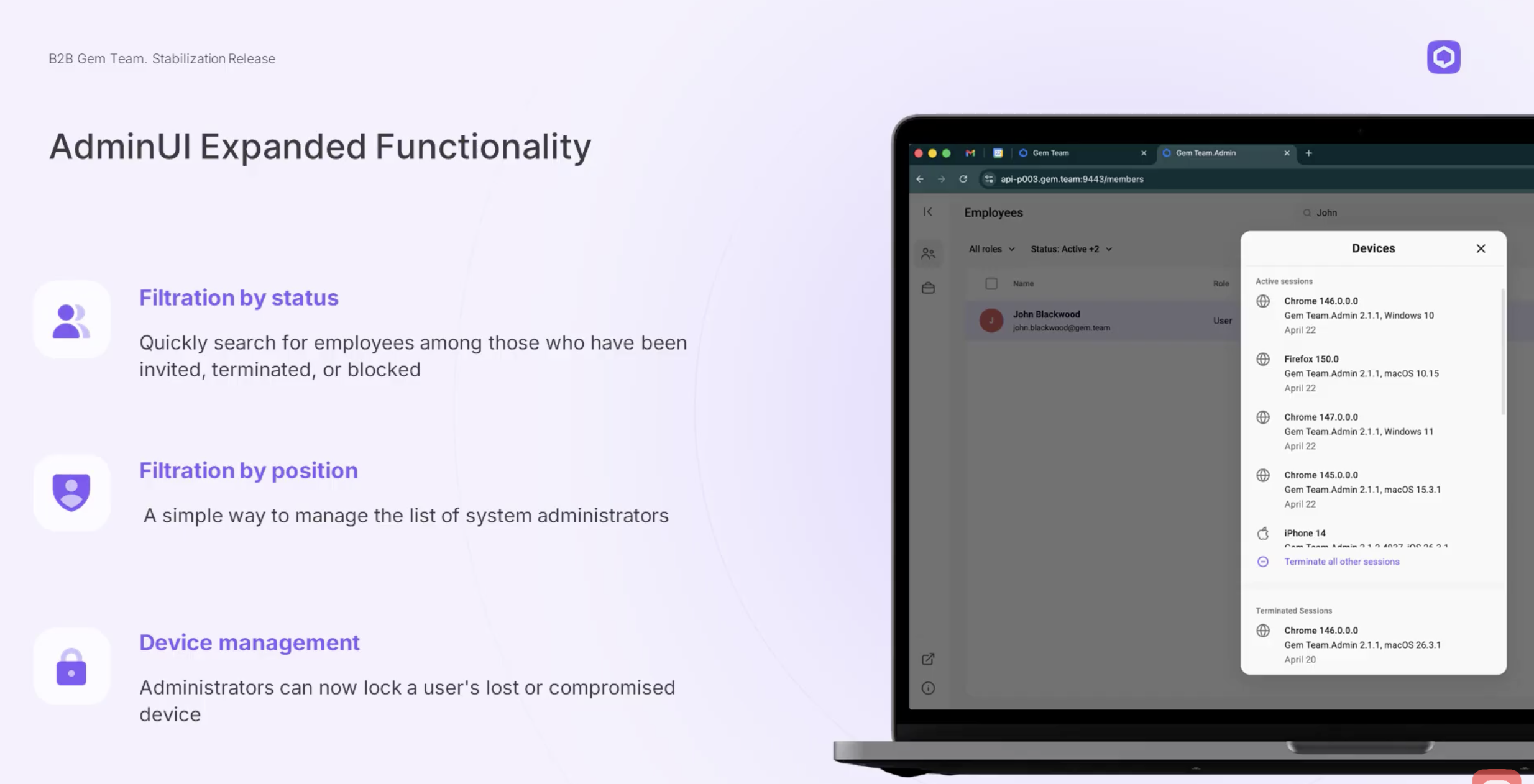
Role-based filtering in the admin panel now gives administrators clear control over who holds admin rights across the system. Status-based filtering makes it easy to track former employees — when they left, what devices they used — and to anonymize their accounts so they can no longer be reached through the platform. Device management is now integrated into the administrator role as well, meaning that if an employee’s phone is lost or suspected compromised, an administrator can block it immediately from the control panel, cutting off any potential data exposure.
Gem Team Cloud: Getting Closer
The cloud solution — designed for small and medium-sized businesses that don’t want or need an on-premise installation — is moving steadily toward its June launch.
A documentation portal is being built directly into the onboarding flow, accessible on any device, in multiple languages, and kept up to date as the product evolves. The idea is simple: users should be able to find answers on their own without needing to contact support for every question. This reduces friction for new users and reduces load on the support team simultaneously.
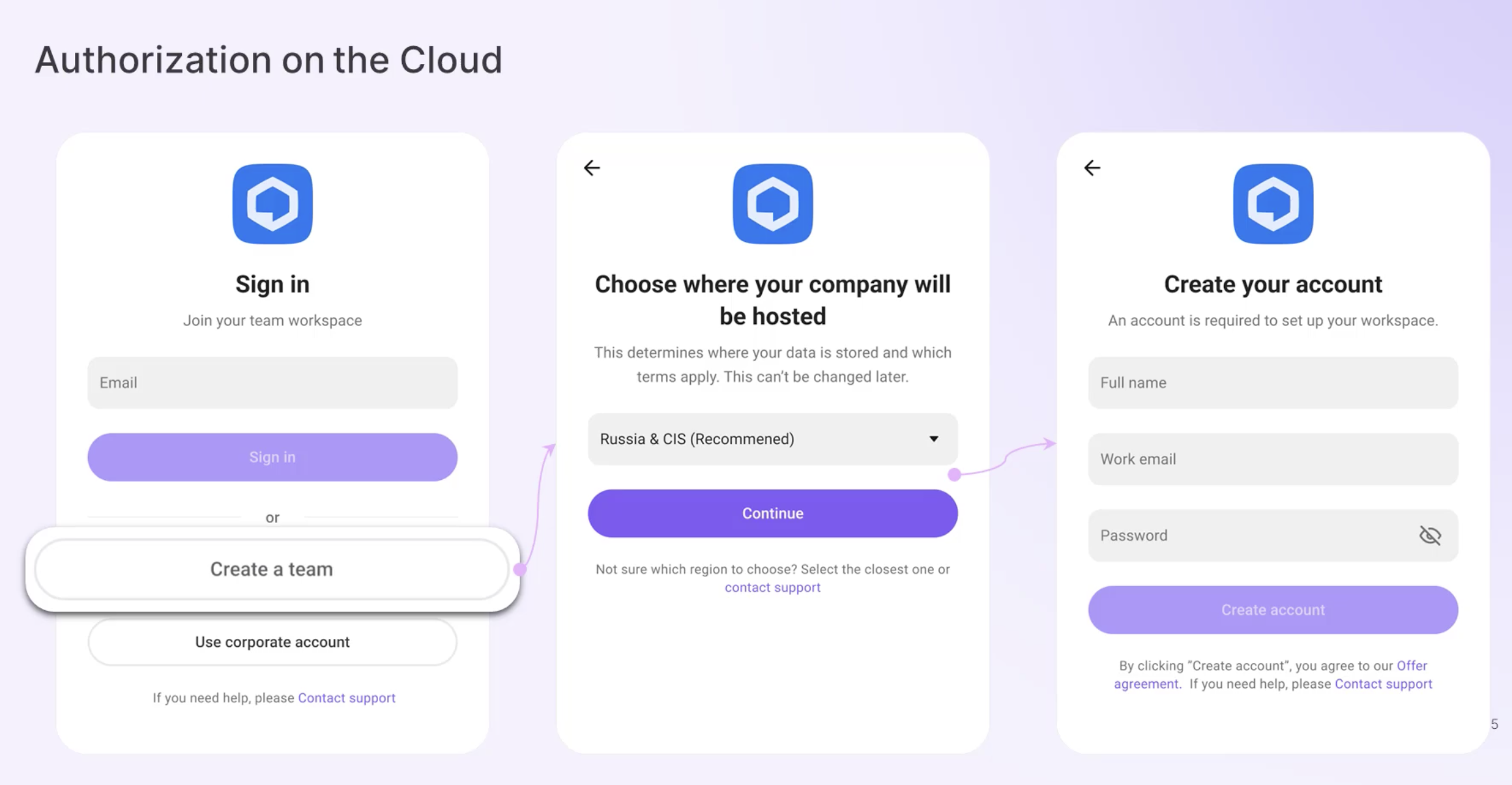
The authorization system is now finalized, offering three paths — cloud access with regional selection, on-premise server access, and new company registration.
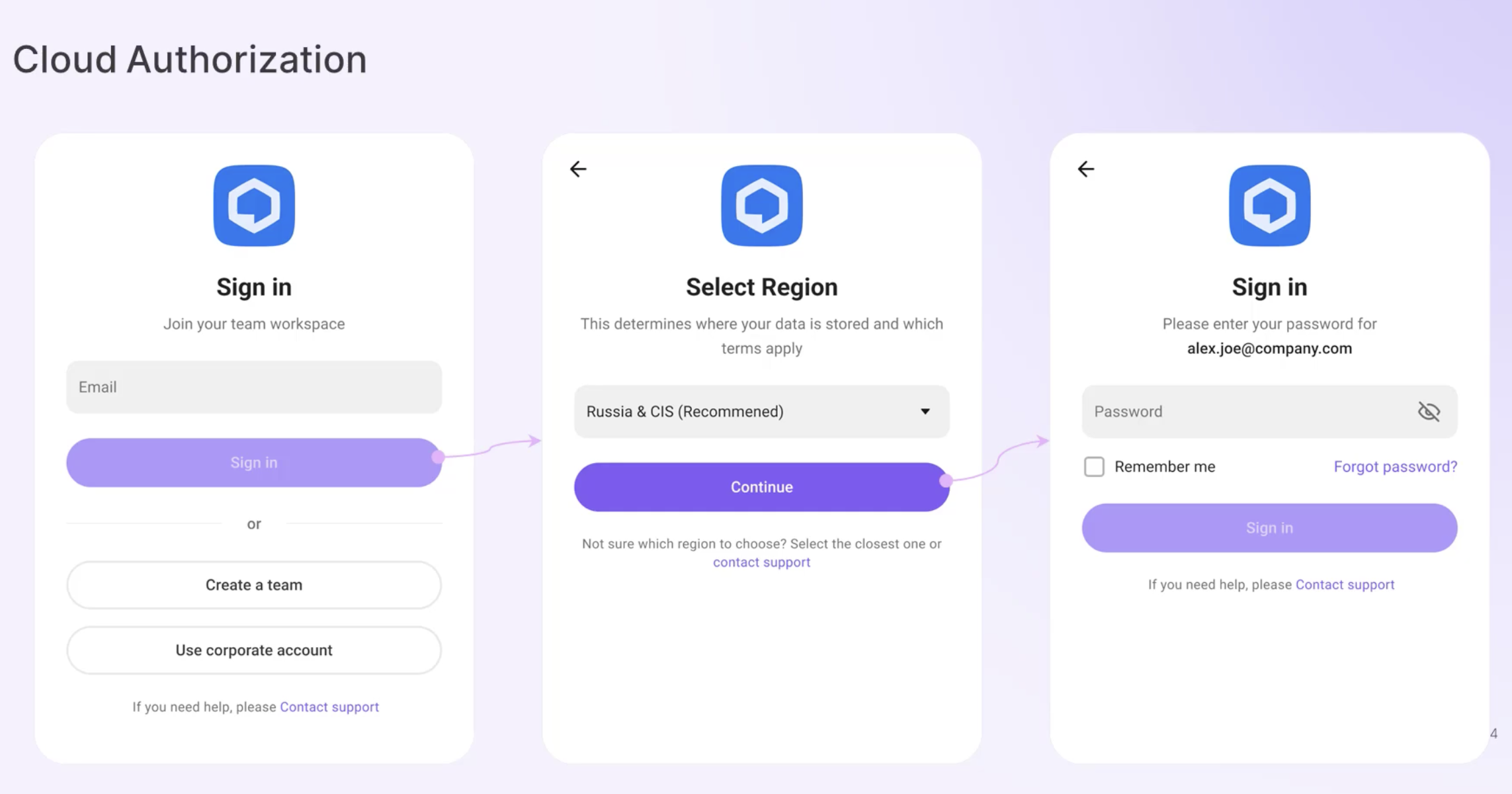
The registration form has been deliberately kept as simple as possible to minimize the barrier to getting started.
A particularly important technical step has been completed for on-premise installations — the mandatory connection back to external servers has been removed. On-premise clients can now run Gem Team entirely within their own network, with no internet access required and no ports that need to be opened. This is a significant security and autonomy improvement, and it is also a key step toward the Gem Team Pod format.
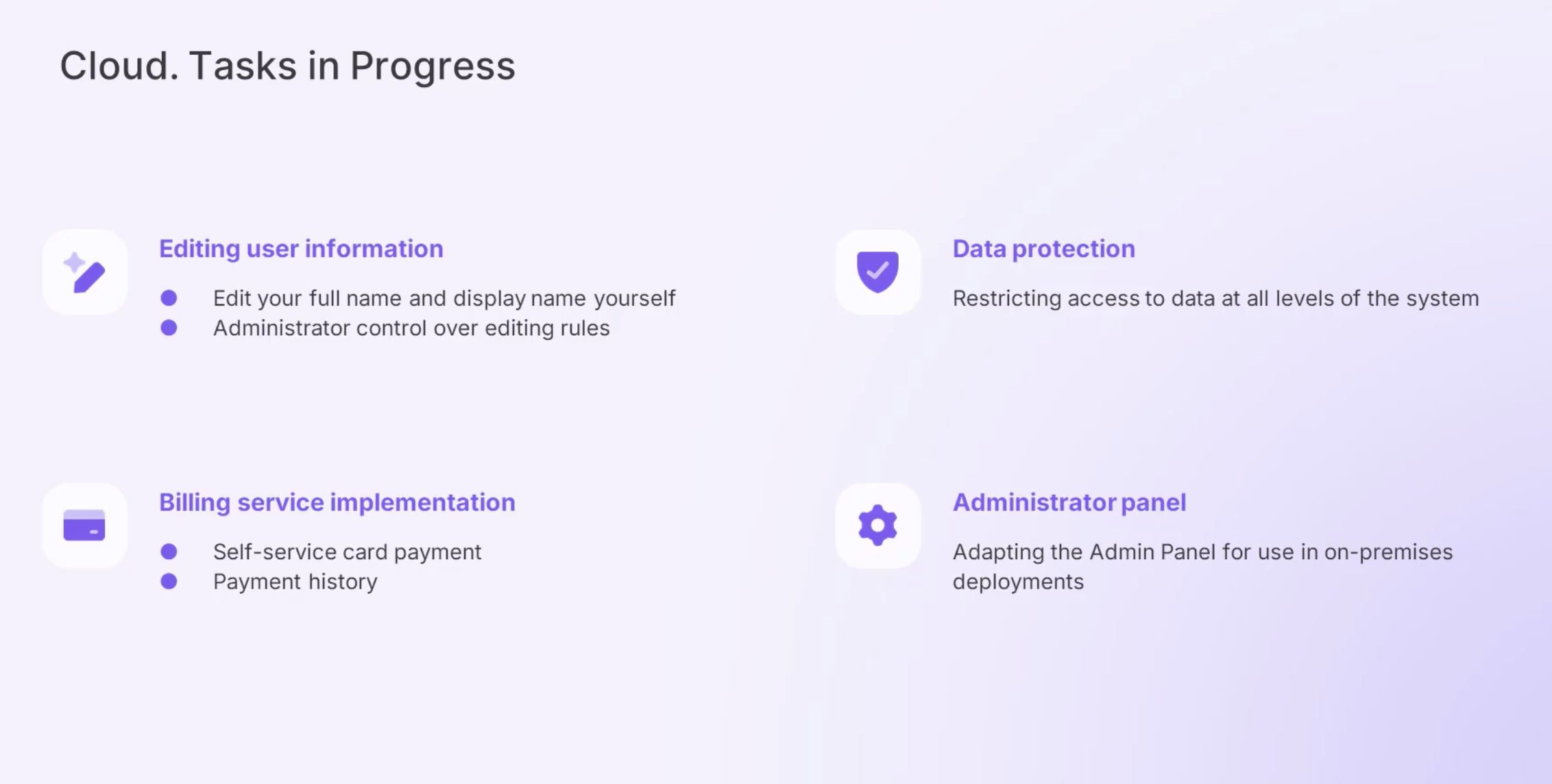
Billing infrastructure is progressing as well — a payment provider has been integrated and tested, with the architecture built to support different regional providers. Users will have full visibility into their payment history, receipts, and invoices.
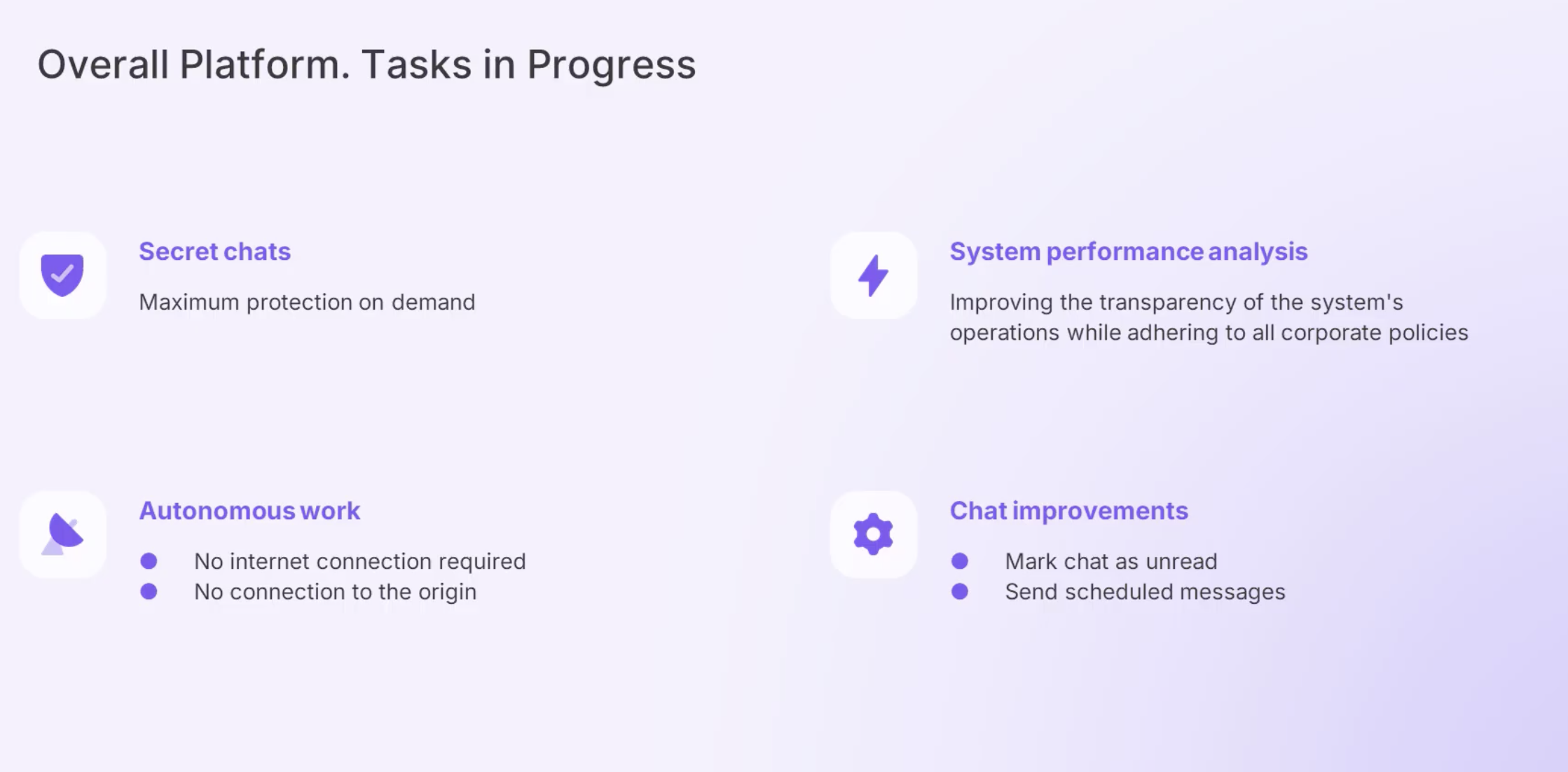
End-to-End Encryption: The Milestone Has Been Reached
This is worth highlighting separately. The development team has successfully sent an encrypted message from one device and decrypted it on another in test environments for secret chats. What this means in practice is that messages in these chats are stored on the server in encrypted form — even if someone were to bypass every layer of protection and reach the database, they could not read the content.
The team is now finalizing the remaining components, polishing the user experience, and stress-testing performance in large chats with hundreds or even thousands of participants. Very few messengers in the world can offer this level of security at this scale. You can count them on one hand.
Two smaller but practical features are also coming with the June cloud release — marking chats as unread and scheduled messages. The latter might seem minor but forms the technical foundation for a range of future automation features within the platform.
Key Questions From Investors
Several important questions were addressed during the briefing.
On regional pricing — there is no fixed number. Country licenses are priced based on the potential active user base and a cost per user. A small country and a country with 300 million people will be priced very differently. Negotiations are active and ongoing.
On competing with Microsoft Teams — the company’s membership in the US-Qatar Business Council is about relationships and market access, not confrontation. Gem Team serves a different focus — offering technology transfer, local hosting, and sovereign control that Microsoft does not provide. The company sells to anyone willing to buy.
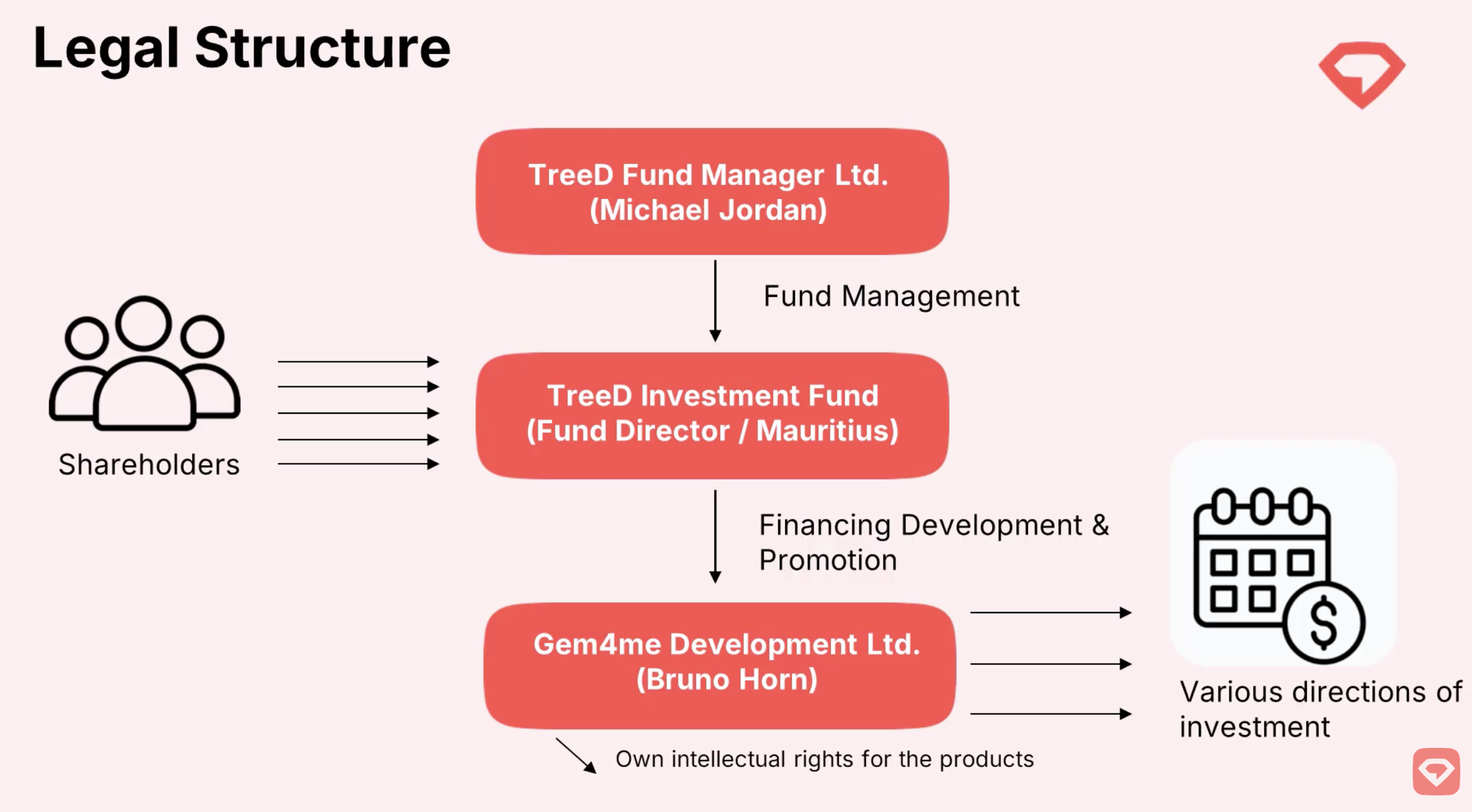
On the legal and ownership structure — shareholders own shares in the ThreeD Investment Fund directly. Gem4me Development Limited holds the intellectual property rights to both products. The fund has a licensed management company. There is no contradiction in the structure — it is designed specifically to protect shareholder rights under Mauritius jurisdiction.
On how contract revenue is distributed — this is one of the more nuanced points and it was addressed in detail. When a contract is signed, the amount received is revenue, not immediate profit. The first license in any new country involves substantial costs — establishing a local entity, deploying and localizing the platform on local servers, going through the full NDA and memorandum process, training the client’s staff, and providing ongoing local support. This is not unique to Gem Soft — every major technology company from Microsoft to Google operates exactly this way when entering new markets. The critical point is that these costs are incurred once per country. Every subsequent license renewal in that country carries a dramatically lower cost base. This means profit margins grow over time and dividend distributions to shareholders grow with them. The split remains 49.9% to shareholders and 50.1% to the company.
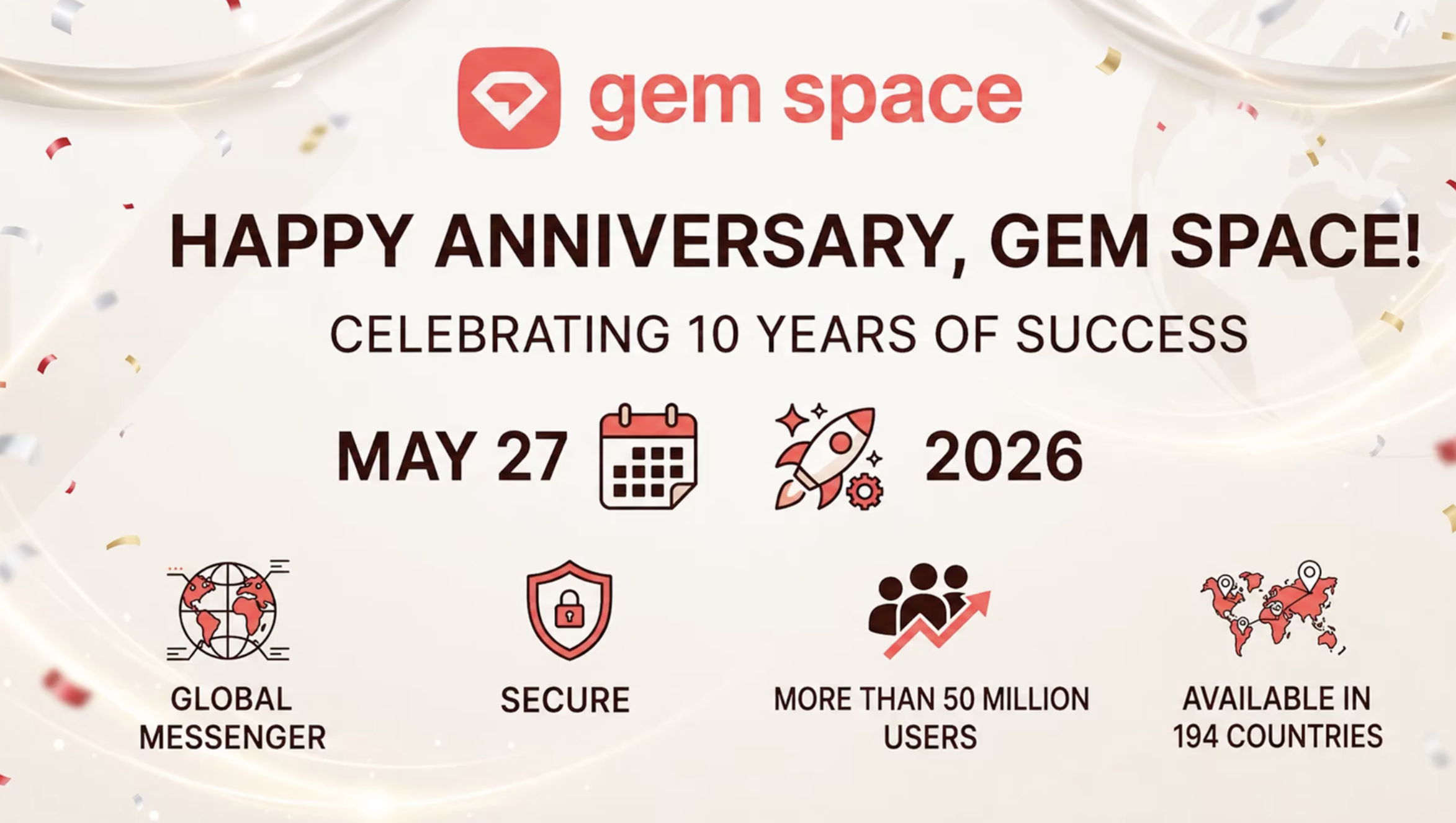
10 Years of Gem Space
On May 27th, 2026, Gem Space turns ten.🎂🥳
The first fully functional version was released on May 27th, 2016 — built without Silicon Valley backing, without venture capital, and without a professional engineering team at the start. Just a group of enthusiasts from countries far removed from traditional tech centers who decided to build a global messenger anyway.
Ten years later: 50 million users, 194 countries, 100 skilled developers, a $2.1 billion independent valuation, and a platform that has grown from a messenger into a multi-product ecosystem — a global super app, a white label sovereign messenger solution for countries and regions, and Gem Team spanning three distinct product tiers.
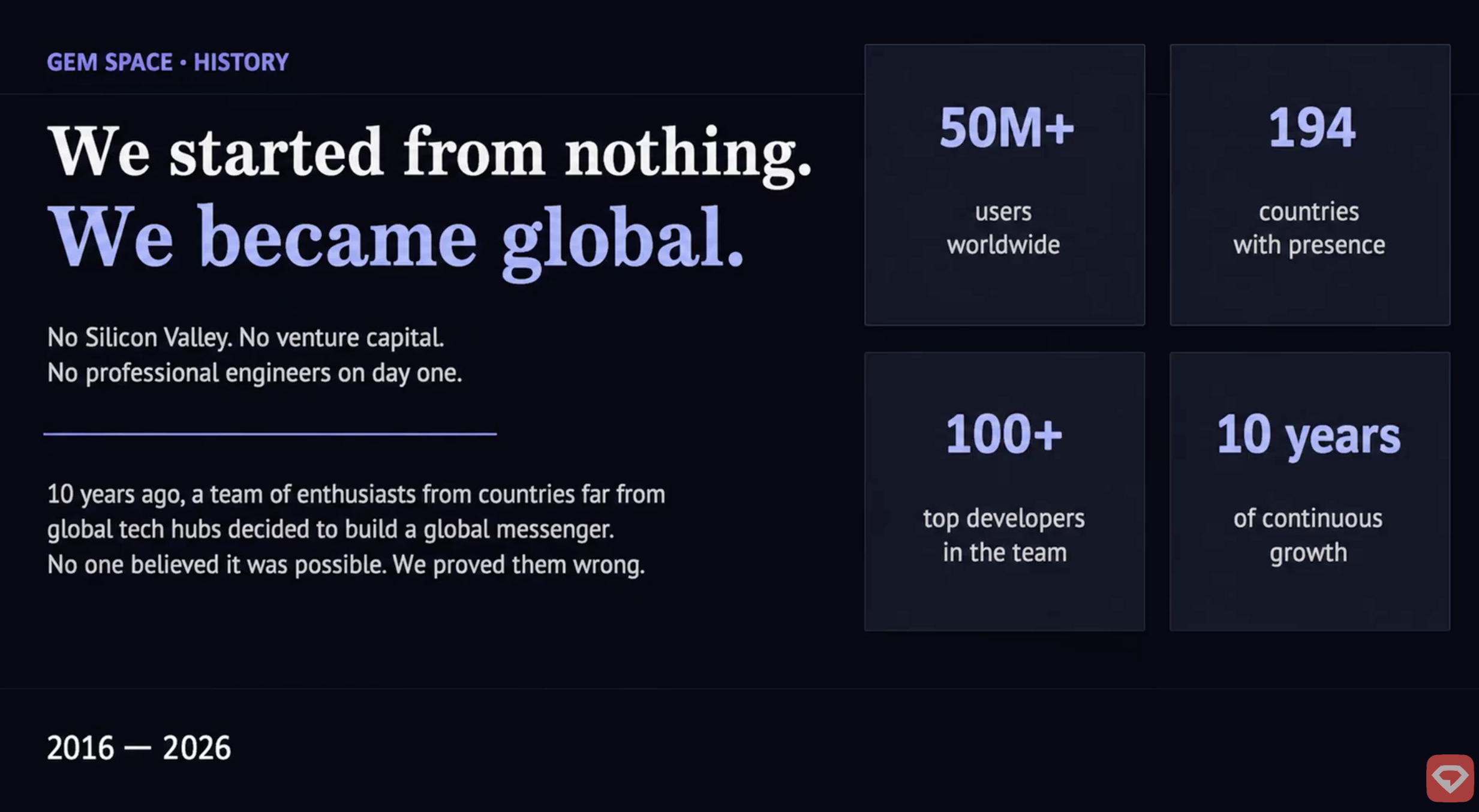
More than 50 messengers launched around the same time — between 2013 and 2018 — have since disappeared. Google tried at least three times to build a global messenger. Gem Space is still here, still growing, and still building.
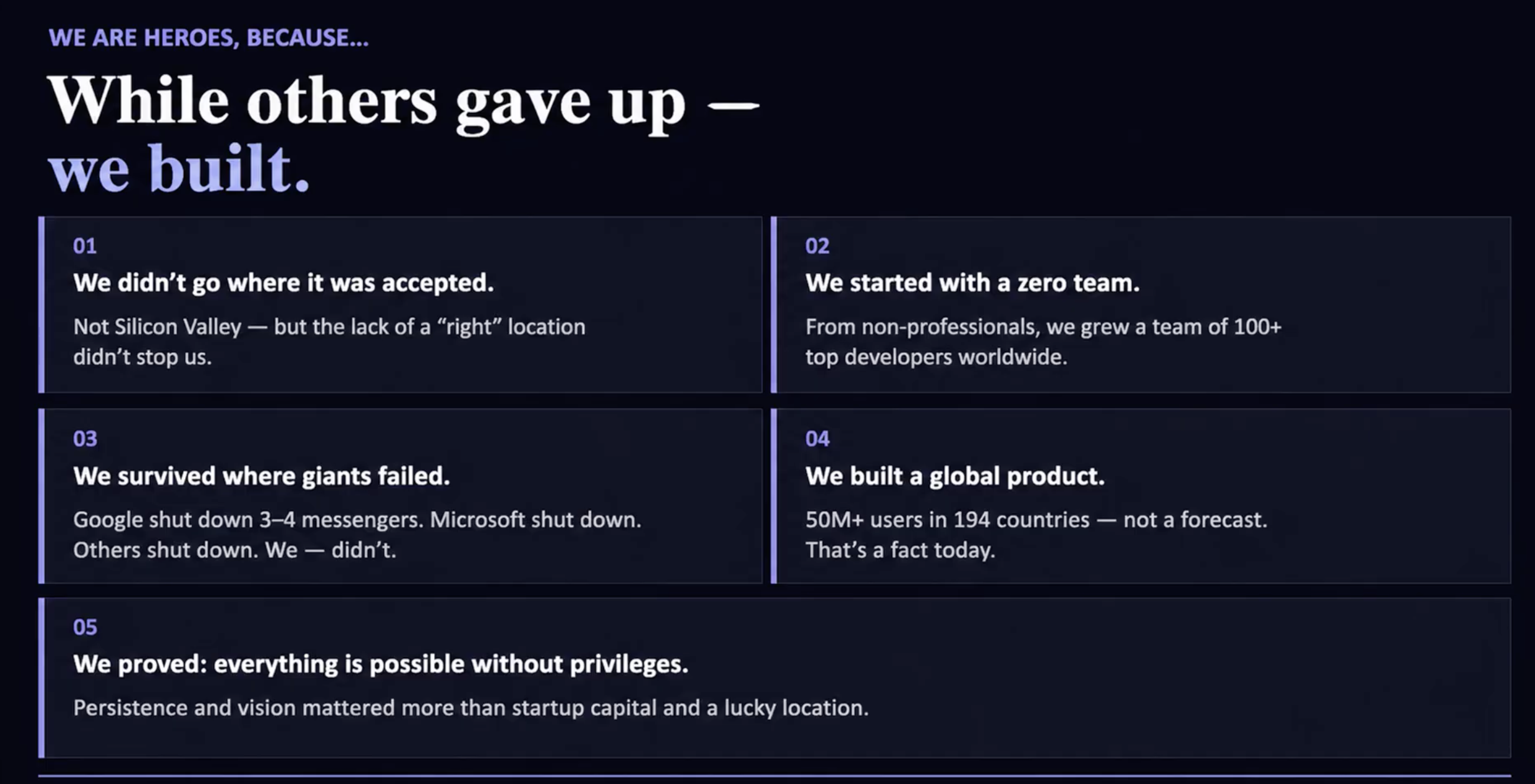
That is worth celebrating.
Stay informed — join our Angels Team channel in Gain Space.
Comments are closed